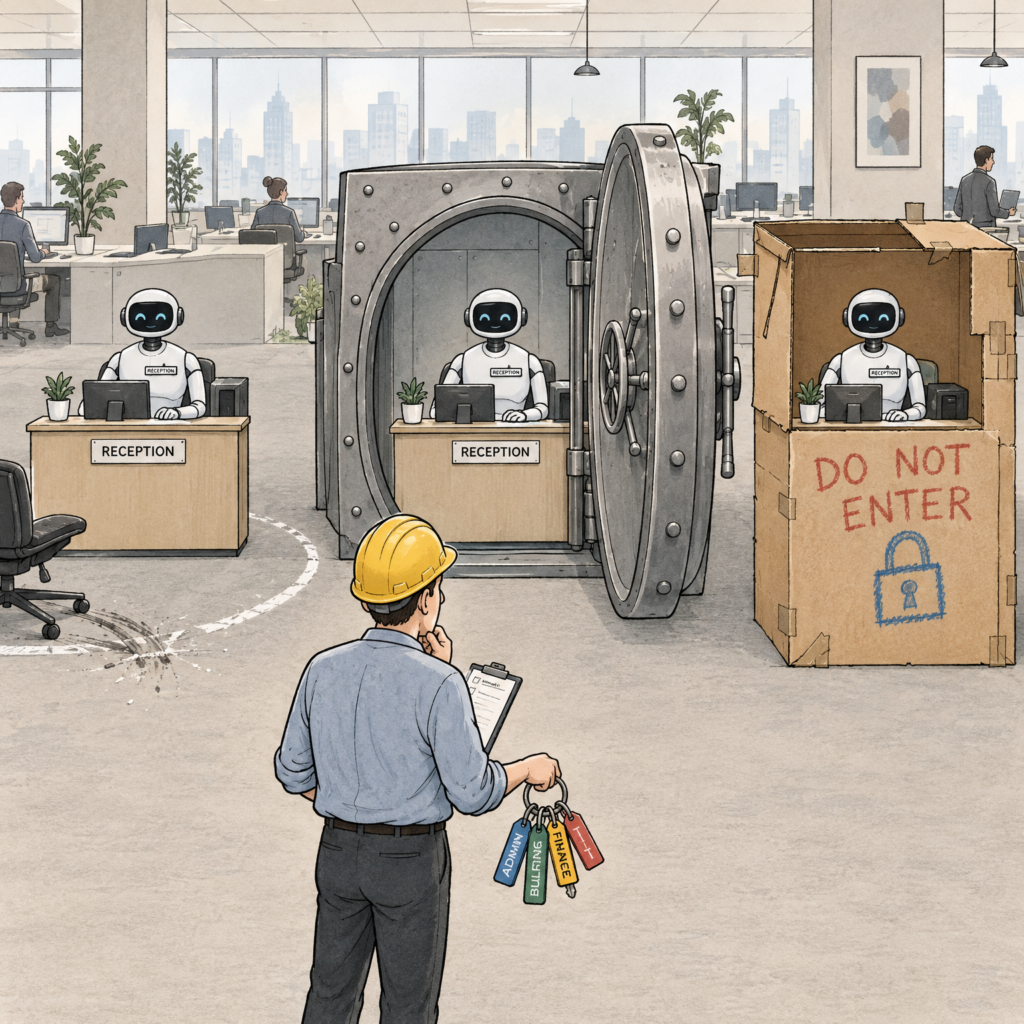
The decision no comparison article will make for you
Three persistent AI agent platforms — OpenClaw, Hermes, and Grok Bot — now let you deploy an agent with a specific job, persistent memory, and live credentials. The interface has converged. The architecture underneath has not. Choosing the wrong one typically means rebuilding from scratch, not just switching a config file.
The non-obvious thesis: these platforms have converged on the same persistent-coworker interface while diverging sharply on what constitutes a security boundary. That architectural gap — not the feature list — is what makes the wrong choice expensive to undo. The actual decision is this: where does your security boundary need to sit, and how much day-one friction can you absorb for long-term efficiency gains? Each platform optimises hard for a different answer. None optimises well for all three.
The four criteria that separate them
Before comparing options, fix the criteria. Every operator running persistent agents faces the same four questions, in roughly this order:
- Security boundary — when one agent goes wrong, what can it reach?
- Learning model — does the agent improve on its own, or only when you configure it?
- Setup cost and ongoing friction — terminal fluency required, or not?
- Model and provider flexibility — locked to one LLM, or swap freely?
Four projects have now come to their own answer on the security question, and no two of them agree. Run each platform through all four lenses and the differences become concrete.
Grok Bot: easiest to start, least flexible to scale
Grok Bot, operated by xAI, provisions and runs the machine for you. You get one computer per account, not one per agent. Every Bot on that account shares the same files and browser logins, so handing work between agents requires no re-authentication or file transfer.
That shared surface is also the security boundary. The documented guidance treats the account itself as the perimeter and advises keeping sensitive credentials off the shared machine entirely. For a solo operator running low-stakes workflows, that trade-off is acceptable. For a team running agents with genuinely different credential sets, it is a structural problem — not a configuration gap you can close later.
Setup is the fastest of the three. Open the app, create an agent, start chatting. No terminal, no YAML, no SSH. Multi-agent work is also the most visually polished — named agents with personalities, direct inter-agent messaging, and visual indicators showing which agent is active.
The binding constraint is model lock-in. Grok Bot locks you to Grok 4.6. If a competing model outperforms it, Grok Bot users wait for xAI to update. OpenClaw and Hermes users switch providers in minutes. In a market moving at this pace, that asymmetry compounds.
Hermes: the learning loop is genuinely different
Hermes draws its security boundary around the profile, not the account. Per-profile credential stores are the documented default, which means several agents with different credential sets can coexist on one workstation without sharing a login surface.
The architectural differentiator is the learning loop. Hermes connects to Atropos, Nous Research’s reinforcement learning framework, which lets the agent train on its own past actions — a process the documentation calls closed-loop learning. The Hermes Curator runs continuously: writing skills from the agent’s work, monitoring which ones get used, and refactoring underperformers, all without operator approval.
OpenClaw shipped its own Skill Workshop in June 2026, but it proposes new skills and waits for human review — a safer, slower flavour of the same idea. The practical consequence: OpenClaw tends to cost more in API tokens over a long run because it lacks the autonomous loop that allows Hermes to reuse learned skills rather than reasoning from scratch each time. That said, the loop pays off over weeks, not hours — token spend in the early learning period will be higher, not lower.
The cost is setup friction. Hermes requires a VPS, command-line configuration, and a manual UI installation step — the web interface does not ship by default. It supports six terminal backends: local, Docker, SSH, Daytona, Singularity, and Modal. The Daytona and Modal options hibernate when idle, which suits agents that sit unused between tasks. Day one, however, Hermes is a thinner toolbox than OpenClaw — the skill library grows from your own usage rather than a pre-built catalogue.
OpenClaw: broadest architecture, highest setup cost
OpenClaw’s security model is the most configurable of the three. It draws the boundary around an optional runtime sandbox — per-agent or per-session container scope with configurable network and tool policy. The critical qualifier: the operator must turn it on and verify it. The docs name specific hazards such as the Docker socket and the shared network namespace. That specificity is a feature. It also signals that the defaults are not hardened.
The catalogue is OpenClaw’s strongest card. As of June 2026, it lists over 50,000 skills — Google Workspace, web scraping, image generation, accounting, and more, installable in one click from the dashboard. It also supports more than 50 AI providers natively, including Anthropic, OpenAI, Gemini, DeepSeek, and local models via Ollama.
Multi-agent architecture is where OpenClaw leads on depth. Multi-node, multi-gateway, multi-agent with shared memory across different communication channels makes it the better fit for complex deployments and customer-facing bots. But setup is the most involved of the three: multi-gateway configuration, agent setup, skill browsing and installation. Worth it for infrastructure-comfortable teams. Painful otherwise.
Trade-offs the comparison videos skip
The strongest objection to recommending Hermes for cost-sensitive operators is the day-one toolbox problem. If you need many integrations working immediately, OpenClaw’s catalogue gets you there faster. The learning loop is a long-run advantage, not an immediate one — and operators should budget for higher token spend during the initial learning period rather than assuming savings from day one.
The strongest objection to OpenClaw’s catalogue is the security story. A community-built library of 50,000 skills carries supply-chain risk that a smaller, self-grown library does not. Operators in regulated environments should audit third-party skills before installation, not after. A lower capture rate on that audit lowers the return on the catalogue investment — this is a real cost, not a theoretical one.
Meanwhile, Grok Bot’s shared-machine model is not a flaw for every operator. A solo founder running a handful of automation workflows on one account gets genuine convenience — always-on availability, no infrastructure bill, no SSH session. The constraint only bites when the credential surface must be segmented. If it never needs to be, the trade-off never materialises.
Recommendation by situation
Use this as a decision filter, not a ranking:
- Persistent work that must run with the laptop closed, single operator, low credential sensitivity: Grok Bot. It is the only one of the four with a vendor-run always-on cloud computer, at the cost of one shared credential surface for the whole roster.
- Several agents with different credential sets on one workstation, long-running deployment, token cost matters over time: Hermes. Per-profile isolation is the documented default and the autonomous learning loop can reduce token spend — after the initial learning period.
- Complex multi-agent deployment, many integrations needed on day one, team comfortable with infrastructure: OpenClaw with the sandbox explicitly enabled and third-party skills audited before installation.
- Low-resource hardware, simple step-based workflows, no heavy orchestration: ZeroClaw. It is documented as the lightweight option for small VPS instances, older laptops, and single-board computers.
None of these platforms is the universal winner. The right one depends on where your security boundary needs to sit and how much day-one friction you can absorb for long-term efficiency gains.
Your next action: Before touching any setup, list your top three automation workflows and answer two questions for each: Does this workflow require credentials that must be isolated from other agents? And does it need to run continuously, or only on demand? If any workflow requires isolated credentials and runs daily, Hermes is worth the CLI setup cost. If all three run under a single account and need to be live quickly, start with Grok Bot — and schedule an architecture review for when the team or credential surface grows.
Eagentix helps growth-focused enterprises redesign and automate manual business processes. We combine executive strategy, implementation support, and managed services to build dependable operations across Southeast Asia.