The output is not the decision
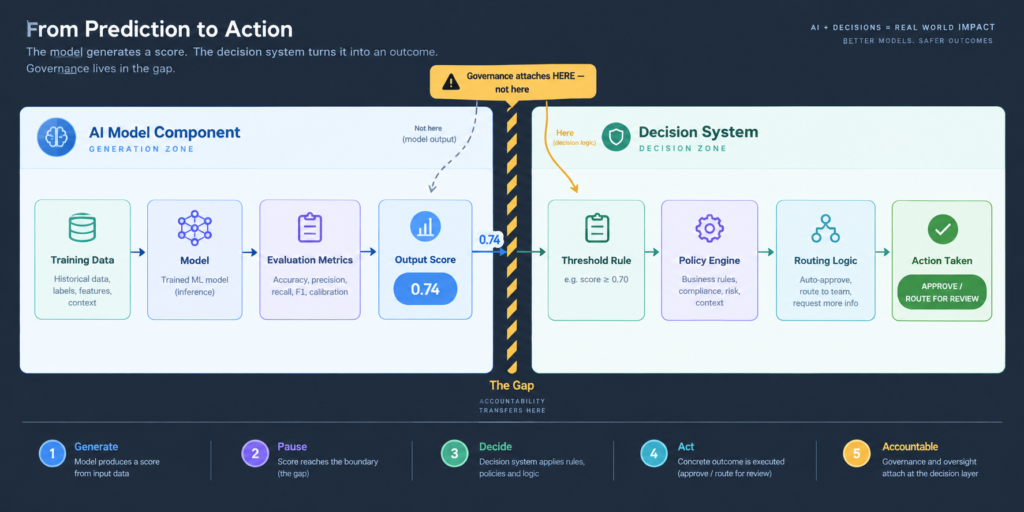
A team trains a model, evaluates it carefully, ships it to production — and then describes it as “making decisions.” But what the model produced was a score, a classification, a ranked list. Something else — a rule threshold, a human reviewer, a downstream policy engine — turned that output into an action. The model generated. The system decided.
That distinction determines who owns accountability, what documentation regulators expect, and whether your governance controls are attached to the right component. Getting it wrong is not a paperwork problem; it is an architectural one.
What the boundary actually means
UNESCO’s definition is a useful anchor. It describes AI systems as “information-processing technologies that integrate models and algorithms that produce a capacity to learn and to perform cognitive tasks leading to outcomes such as prediction and decision-making.” The phrase “integrate models” is load-bearing: a model is a component; a system is the assembly that converts that component’s output into a real-world outcome. Fernández-Llorca et al., arXiv, March 2026
Teradata’s AI decision-making framework makes this operational by separating four elements: data, model, rules and constraints, and decision logic. The model scores risk. The rules define permissible actions. The decision logic — “if risk_score < threshold and the customer is eligible, approve; otherwise, route for review” — is what actually selects the action. Teradata, February 2026 Strip out the decision logic and you have a capable number generator. Add it back and you have a system that acts.
The operative question shifts accordingly: not “does our model make good predictions?” but “does our decision logic correctly translate those predictions into the right actions, within the constraints our business and regulators require?”
Why the conflation keeps happening
Most teams build the model first and attach the decision logic later, often informally. A threshold gets hardcoded. A routing rule gets embedded in application code rather than in a governed policy layer. Nobody documents it because it feels like engineering plumbing, not an AI artefact. Then an auditor asks: “What is your model’s decision boundary for credit approval?” The answer lives in three different places, owned by two different teams, with no version history.
OpenAI’s published account of its own Model Spec work surfaces the same structural problem at a different scale. Their production models “do not yet fully reflect the Model Spec for several reasons” — meaning the specification of intended behaviour and the actual behaviour of the deployed system remain partially decoupled. OpenAI, August 2026 If the organisation that builds the model cannot fully close that gap, operators deploying third-party models face a steeper climb still.
ISPE’s seven-layer control framework for LLMs in GMP environments names the evidentiary dimension explicitly. Transparency gaps between what a proprietary model supplier documents and what a regulated manufacturer needs to prove constitute “an evolving compliance consideration.” ISPE Pharmaceutical Engineering, September 2026 The gap is not just technical; it is evidentiary.
The counterpoint worth taking seriously
A reasonable objection: for many use cases, the model output and the decision are effectively the same thing. A content moderation classifier that flags a post for removal — where no human reviews the flag before action — is both generating and deciding. Insisting on a conceptual separation adds process without adding safety.
That objection is fair, and it sharpens rather than defeats the point. When the model output and the action are identical, the model card must say so explicitly. Current documentation guidance states that a credit risk model intended as “decision support (not sole decision-making)” must state that limitation clearly. TechAhead, August 2026 If the model is instead the sole decision-maker, the governance burden is higher, not lower. The separation matters either way; it just resolves differently depending on the architecture.
Three things operators need to do differently
First, map the decision logic as a governed artefact, not application code. Every threshold, eligibility rule, and routing condition that converts a model score into an action belongs in a versioned policy layer — one that updates in sync with model retraining. Documentation guidance is direct on this: static documentation fails the moment you deploy a new model version without updating the record. TechAhead, August 2026 The same principle applies to decision logic, which is at least as consequential as the model card itself.
Second, classify each model by its autonomy level before writing its documentation. The GSA’s AI Agent Specification template requires classifying each agent’s “fundamental operational model” — specifically its “level of autonomy” and “primary mode of decision-making” — as the foundation for all subsequent governance decisions. GSA-TTS, November 2025 That classification determines which controls apply, what human-in-the-loop checkpoints are warranted, and which failure modes require documentation. Without it, a model inventory cannot distinguish high-risk obligations from minimal ones.
Third, build explainability at the decision layer, not only at the model layer. Teradata’s framework distinguishes local explanations — reasons for individual decisions, counterfactuals, rule triggers — from global transparency about model objectives and known limitations. Teradata, February 2026 Regulators and affected individuals typically need both. A model that explains its score but cannot explain why that score triggered a specific action has answered the wrong question.
The one thing to do this week
Pick your highest-stakes production model. Write down, in plain language, the exact decision logic that converts its outputs into actions — every threshold, every routing rule, every human review trigger. Then ask three questions: Is that document versioned? Does it have a named owner? Does it update when the model retrains? If the answer to any of those is no, you have located the gap. Closing it is the governance work that most directly reduces exposure — not the model card, not the bias audit, but the decision logic sitting between the score and the action.
— Eagentix
Eagentix helps growth-focused enterprises redesign and automate manual business processes. We combine executive strategy, implementation support, and managed services to build dependable operations across Southeast Asia.
Sources
- Source: Defining AI Models and AI Systems:A Framework to Resolve the Boundary Problem (
- Source: AI Model Cards & Data Provenance: 2026 Compliance Guide (
- Source: (PDF) Decision-making models and tools: a critical study (
- Source: Inside our approach to the Model Spec (
- Source: devCrew_s1/docs/templates/AI Agent Specification Template.md at master · GSA-TTS/devCrew_s1 · GitHub (
- Source: AI Decision-Making and Decision Engines: Guide | Teradata (
- Source: Seven Control Layers for LLMs in GMP Decision-Making | Pharmaceutical Engineering (