The Architecture You Didn’t Design for AI
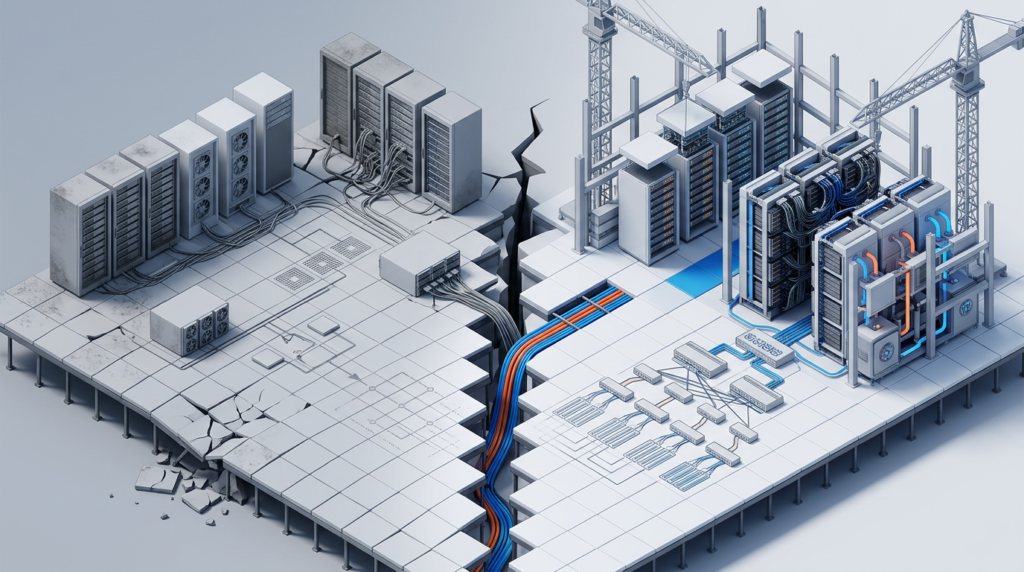
Nobody designed their infrastructure for AI. That’s not a criticism — it’s arithmetic. The multicloud decisions most enterprises locked in before 2020 were reasonable answers to the questions that existed then. Raised floors. Air cooling. Private-cloud virtualization. Standard Ethernet switching. All of it sensible for the workloads of that era.
A Deloitte Insights interview subject put the gap plainly: “The infrastructure many enterprises have today was designed for the pre-AI era and based on an architectural decision made when the multicloud era began. Businesses made these decisions — like which cloud to use, the topology, what to do on-prem versus off-prem — probably before the pandemic. No one is that smart or lucky to have designed their architecture for a thing that didn’t exist when they designed it.” Deloitte Insights, 2026
That gap — between what enterprises built and what AI demands — is now the central infrastructure problem of the decade. A growing body of capital is betting it forces a rebuild cycle larger than anything since virtualization.
Why the Mismatch Is Structural, Not Incremental
The thesis from Andreessen Horowitz is specific. AI training and inference workloads require thousands of GPUs communicating constantly across multi-layer switch fabrics. A single AI cluster can demand thousands of switches organized across multiple network layers — an architectural requirement that did not exist when cloud-era enterprise infrastructure was designed. A16z, March 2026
The firm’s own language is direct: “Even today’s state-of-the-art switches can’t keep up. At every layer, networking is the bottleneck between GPU capacity and GPU output.” Andreessen Horowitz, March 2026
Raghu Raghuram, now a partner at a16z, frames the scope: “AI is now triggering the biggest infrastructure reset since virtualization.” Andreessen Horowitz Podcast, October 2025
The mismatch isn’t a configuration problem. It isn’t solved by a firmware update or a new cloud region. Legacy automation was never built for multi-fabric GPU clusters. Legacy networking topologies were never designed for InfiniBand interconnects. These are foundational incompatibilities — and patching them typically produces a slower, more expensive version of the wrong architecture.
The Capital Signal Is Already Loud
A16z’s portfolio moves make the conviction tangible. In March 2026, the firm led a $500 million Series B in Nexthop AI — explicitly framed around replacing cloud-era networking switches that cannot meet AI cluster bandwidth and latency demands. A16z, March 2026
Three months later, a16z invested $15 million in Netris’s Series A to replace legacy network automation with AI-native multi-fabric management. Martin Casado’s framing at the time: “We’re in the early innings of the largest growth and compute we’ve ever seen in the AI wave. It will need SDN-type approaches. It will need what Netris is doing. So we think this is going to be the standard for every company going forward.” Futuriom, June 2026
Netris itself reports 35+ live deployments across major AI clouds — evidence the rebuild cycle is already in progress. The firm also launched its Machine Age Fund, with Horowitz, Casado, Raghuram, David Ulevitch, and David George collectively signaling that the infrastructure layer — not the model layer — is where foundational value accrues this decade.
Futuriom estimates at least $800 billion will be spent on AI infrastructure in 2026 alone, with trillions projected to follow over the next several years. Futuriom, June 2026 At that scale, the rebuild is the decade’s largest capital allocation event — not a line item in an IT refresh cycle.
The Counterpoint Worth Taking Seriously
The strongest objection: most enterprises don’t run AI at hyperscaler or frontier-lab scale. If your workloads are modest — a handful of inference endpoints, a few fine-tuning jobs — existing infrastructure may be adequate for years. Ripping out functional data center architecture to chase an architectural ideal is a genuine way to overspend and underdeliver.
That objection is legitimate, and it doesn’t dissolve under pressure. But it addresses a different claim than the one being made. The rebuild cycle argument is not that every enterprise needs to replace everything now. It is that the architectural decisions made in the near term will determine whether infrastructure scales with AI demand or becomes a ceiling on it. Enterprises with modest workloads today may face that ceiling sooner than their procurement cycles allow for.
The firms getting ahead of this aren’t doing wholesale rip-and-replace. They’re building three-tier hybrid architectures that assign workloads by what each layer is actually good at — not by prior vendor commitments. Deloitte’s 2026 research shows leading enterprises have already moved to these models. Deloitte Insights, 2026 The cloud-versus-on-premises binary is functionally over. Workload placement is the new question — and it requires a deliberate answer, not a default inherited from a pre-pandemic procurement.
What This Means for Founders and Executives Right Now
Audit your network automation layer before you scale GPU clusters. Legacy automation tools were designed for virtual machine orchestration, not multi-fabric GPU environments. Scaling AI workloads on top of them typically produces unpredictable latency and operational debt that compounds. The Netris investment thesis rests precisely on this failure mode being widespread — and the 35+ reported deployments suggest it is.
Treat networking as the binding constraint, not compute. The instinct when AI workloads slow down is to procure more GPUs. But if the switch fabric between GPUs is the actual bottleneck — which a16z’s Nexthop investment explicitly argues it is — adding compute accelerates the constraint, not the throughput. Diagnose the fabric before you procure the hardware.
Map workloads explicitly across three tiers. Which workloads belong on-premises for latency or data-sovereignty reasons? Which belong in a hyperscaler cloud for elasticity? Which require a purpose-built AI cloud layer for cluster-intensive training and inference? Enterprises that answer this deliberately — rather than inheriting the answer from a 2019 procurement decision — are building infrastructure that scales with demand rather than against it.
The rebuild cycle Horowitz and Casado are betting on may be the largest infrastructure reset since virtualization. You don’t have to accept that framing to act on the operational logic underneath it.
If this framing is useful, subscribe for weekly breakdowns — or reply with where your own infrastructure decisions are getting stuck. I read every response.
— Abhijit Ghosh
Eagentix helps growth-focused enterprises redesign and automate manual business processes. We combine executive strategy, implementation support, and managed services to build dependable operations across Southeast Asia.
Sources
- – AI infrastructure compute strategy | Deloitte Insights
- – Why Your AI Agents Keep Getting the Wrong Answer – Streamkap
- – Investing in Nexthop AI | Andreessen Horowitz
- – Raghu Raghuram: AI, Robotics, and the Rebirth of Infrastructure | Andreessen Horowitz
- – Death of Software. Nah. | Andreessen Horowitz
- – A16z and Netris Get the SDN Band Back Together – Futuriom
- – Good news: AI Will Eat Application Software | Andreessen Horowitz
- – The Architects of AI: Person of the Year 2025
- – The Trust Wall: Why AI’s Next Billion Users: Will Come Through Trust Networks
- – a16z: The Power Brokers – Not Boring by Packy McCormick
- – Building Your Cloud Computing Stack | Mirantis
- – Cloud Native: A Business Strategy for Innovation & AI | Nutanix
- – Best Infrastructure for Scalable AI Inference | Mirantis
- – AI Infrastructure Explained: How to Build Scalable LLM and ML Systems | Splunk
- – What Is an AI Cloud? | AI Cloud Explained
- – Ecosystem Architecture — NVIDIA Enterprise AI Factory Design Guide White Paper
- – Accelerating AI/ML Workloads on OCI: Integrating Hammerspace with the OCI HPC/GPU Stack | cloud-infrastructure
- – Why GPUs Became the Foundation of AI: A GPU Primer for K8s …
- – The Essential Cloud for AI: A Defining Year
- – The Memory Wall and the Future of AI Infrastructure | Pat Gelsinger on a16z|a16z — BigGo Finance
- – Tracking Trillions: The Assumptions Shaping the Scale of the AI Build-Out
- – Why Texas Is Making Data Centers Wait | Andreessen Horowitz
- – The Memory Wall and the Future of AI Infrastructure | Pat Gelsinger on a16z
- – Surviving the AI Sprint: up close with Google Cloud and Cisco
- – The New Economics of AI | Martin Casado & Steven Sinofsky | Andreessen Horowitz
- – Your Data Agents Need Context | Andreessen Horowitz
- – State of AI: An Empirical 100 Trillion Token Study with OpenRouter | Andreessen Horowitz
- – You are not a model. Don’t price per token. | Andreessen Horowitz