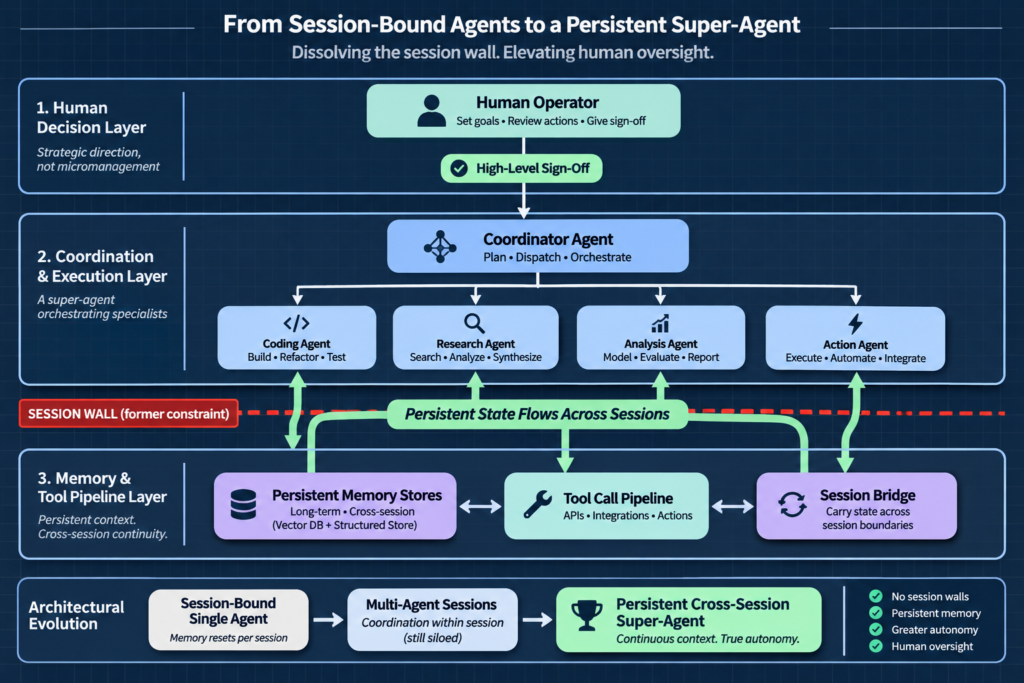
The session model is the constraint, not the model
The dominant mental model for AI agents has been a session: you prompt, the agent runs, the session closes. DeepSeek Harness recently published an architectural essay — originally in Chinese, available in machine translation — that argues this boundary is now the primary constraint, not model capability. The essay is titled Exploring Super-agent Design: Towards a More Autonomous Agent System. Read the source here.
The authors are clear about scope from the outset: “This article discusses architectural ideas. It is not an introduction to existing features of DeepSeek Harness.” This is a proposal, not a release. That distinction matters for how you weight it — but proposals that identify a real structural constraint tend to shape roadmaps whether or not the proposing team ships first.
What the blueprint actually argues
The essay’s starting observation is that single-task agents have already cleared a meaningful bar. As DeepSeek Harness puts it: “Over the past year, coding agents and other single-task agents have shown that models can use tools to solve complex problems while needing less and less continuous monitoring and step-by-step intervention from humans.”
The architectural move they propose follows from that: if single-task agents can run reliably within a session, the next constraint is the session boundary itself. The essay argues that cross-session coordination is now tractable: “Models have also become better at coordinating multiple agents, which makes it practical to organize and schedule work across sessions.”
The result is a design direction toward persistence — agents that hold state, maintain context, and continue working between human touchpoints rather than restarting from zero. The human role shifts accordingly: “As people take less part in low-level execution, their role is gradually moving up to higher-level decisions and sign-off.” That is a change in how you design oversight, not just how you write prompts.
The failure mode asymmetry is real
The strongest objection to this architecture is not philosophical — it is about failure modes. Session-bound agents fail in contained, recoverable ways. A persistent agent that holds state and coordinates subagents across time can fail in compounding ways that are harder to audit. A bad decision made at hour one keeps propagating if the agent continues running.
Anthropic’s research on managed agents engages a related tension directly. Their work on scaling managed agents frames it as decoupling the brain from the hands: reasoning should be centralised and auditable even when execution is distributed and asynchronous. That framing does not eliminate the failure mode — it describes the architectural condition under which the failure mode becomes manageable.
The DeepSeek Harness blueprint does not resolve this tension either. What it does implicitly assume is that the answer lies in checkpoint design and escalation protocols — human sign-off moving up the decision stack, not disappearing from it. That is a defensible position. It also means the governance layer becomes structurally load-bearing in a way it is not in session-bound deployments. Teams that treat governance as a later concern are making a bet that may not pay off.
Three things to build before you need them
If this architectural direction holds — even partially — several things follow for teams building on or with AI systems today.
Approval workflows designed for synchronous decisions will break under asynchronous agents. Most enterprise approval flows assume a human is present at the moment a decision is made. Persistent agents act between check-ins. Escalation triggers, audit logs, and rollback procedures need to be designed around time gaps, not just decision points. The gap is where the risk accumulates.
State management is a product and compliance decision, not an infrastructure detail. Session-bound agents let you treat memory as ephemeral. Persistent agents do not. What an agent remembers, how long it retains that memory, and who can inspect or override it carries product, legal, and security dimensions. Teams that defer this to the backend will encounter it later as a compliance problem — at a point when it is harder to redesign.
“Human in the loop” is too coarse a description to be operationally useful. The loop is not disappearing — it is lengthening and moving up the decision stack. That requires a tiered escalation definition: which decisions always require human sign-off, which can proceed autonomously with logging, and which should pause and wait for review. Teams that specify this now will have a governance framework in place when persistent agents become the default deployment pattern. Teams that do not will be retrofitting under pressure.
None of this requires waiting for DeepSeek Harness to ship. The architectural pressures are already present in the systems running today. The blueprint makes the direction explicit.
— Abhijit Ghosh
Eagentix helps growth-focused enterprises redesign and automate manual business processes. We combine executive strategy, implementation support, and managed services to build dependable operations across Southeast Asia.