The CFO Is About to Walk Into Your AI Review
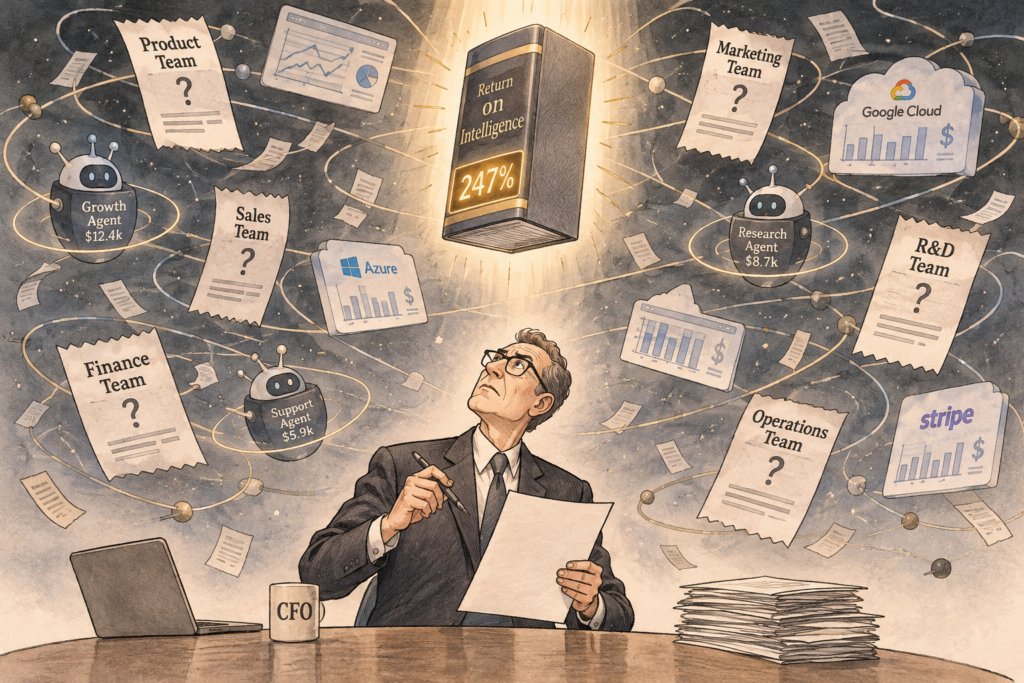
AI spending inside most companies is structurally invisible. A team spins up an agent. Another buys API credits. A third embeds a model into a workflow nobody else can see. Finance knows something is happening — the cloud bills confirm it — but nobody can tell the CFO what any of it produced.
That is the gap Satya Nadella named at Microsoft Ignite when he announced Agent 365 Business Analytics: “You can think of this as your ERP system for AI, helping organizations connect spend to business value and continuously optimize their return on intelligence.” Source: Satya Nadella on X
The framing is worth taking seriously on its own terms, separate from the product announcement behind it.
Why the ERP Analogy Is Precise
ERP systems solved a specific structural problem: money moving across procurement, inventory, payroll and sales, each tracked in its own silo. The question “are we profitable on this product line?” could take weeks to answer, if it could be answered at all. Integrated financial systems made that question answerable in real time.
AI spend today has the same architecture problem. Token costs, inference compute, fine-tuning runs, agent orchestration overhead — these live across cloud billing dashboards, external API portals, internal tooling and individual team budgets. There is no consolidated view. There is no reliable answer to “what did that agent deployment actually return?”
Agent 365 Business Analytics is Microsoft’s bet that it can own that ledger. The harder implication of the framing is this: if you need an ERP layer to manage AI, then AI has already become infrastructure — with the accountability obligations that word carries, not just the technical ones.
What “Return on Intelligence” Actually Demands
Nadella’s phrase “return on intelligence” is doing real work here. It implies that AI deployments should be evaluated the way capital investments are — with a measurable outcome attached to each one. That is a higher bar than most organisations currently clear.
Most AI deployments today are justified by capability, not by outcome. A team adopts an agent because it can automate a task, not because someone has committed to measuring whether it does. The ERP analogy exposes why that is insufficient. No CFO would accept a procurement system that tracked purchase orders but could not connect them to inventory levels or margin. Yet that is roughly the state of AI spend governance in most enterprises right now.
So the practical demand is specific: each active deployment needs a named business outcome — cost avoided, revenue influenced, cycle time reduced — and an auditable trail connecting the AI action to that result. Without that trail, “return on intelligence” remains a slogan rather than a control.
The Strongest Counterpoint
Microsoft is selling a product. Agent 365 Business Analytics is a commercial offering, and Nadella’s framing conveniently positions that product as essential infrastructure. “Return on intelligence” is language designed to create urgency. It is reasonable to be sceptical of a vendor defining the problem its own solution solves.
That scepticism is legitimate and worth keeping. But it does not dissolve the underlying governance gap. The CFO conversation about AI spend accountability will arrive regardless of which tool an organisation uses to prepare for it — or whether it prepares at all. Dismissing the framing because of its commercial context is a way of deferring a real problem, not refuting it.
The operative question is not whether to trust Microsoft’s product roadmap. It is whether your organisation can currently answer, with evidence: which AI deployments are generating measurable business value, and which are consuming budget without a traceable return?
What This Means in Practice
Three things follow from taking Nadella’s framing seriously.
AI ROI reporting needs to become a standard control, not a retrospective exercise. Map each active deployment to a measurable business outcome with an auditable trail connecting the AI action to the result. Build that layer now, in whatever tooling fits your stack, before the board requests it.
Spend visibility needs to consolidate across every surface where AI costs accumulate. That means a single owner — typically a combination of finance and engineering leadership — responsible for aggregating token costs, compute charges and orchestration overhead into one view. Distributed billing across teams is how accountability disappears.
The governance vendor landscape will get crowded quickly. Microsoft has named the category; others will follow with competing frameworks and dashboards. One useful filter when evaluating them: can the tool connect a specific AI action to a specific business outcome with an auditable trail? A tool that cannot do that is a reporting interface, not a control system. The distinction matters when something goes wrong and you need to explain what happened.
— Abhijit Ghosh
Eagentix helps growth-focused enterprises redesign and automate manual business processes. We combine executive strategy, implementation support, and managed services to build dependable operations across Southeast Asia.
Eagentix helps growth-focused enterprises redesign and automate manual business processes. We combine executive strategy, implementation support, and managed services to build dependable operations across Southeast Asia.