A quarter-century in the making
Tang Jie had a line on his personal website that read something like a mission statement: “I am putting all my effort into artificial general intelligence with the mission of teaching machines to think like humans.” He wrote that several years ago. But the ambition behind it goes back roughly 25 years — to when Tang was already working on machine learning while most of Silicon Valley was still arguing about banner ads.
So when people ask how Chinese AI labs got so far so fast, the honest answer is: they didn’t. Not really. The speed is visible now. The work was invisible for decades.
Tang is a professor at Tsinghua University. He co-founded Z.AI, now valued at tens of billions of dollars and described by reporters covering the beat as hot on the heels of Anthropic and OpenAI in both capability and global usage. One of his former students, Yang Zhilin — someone Tang once nominated for Tsinghua’s top academic award — went on to earn a Ph.D. at Carnegie Mellon, returned to China, and eventually started his own company. Yang called it “Dark Side of the Moon” in Chinese, riffing on the Pink Floyd album. In English: Moonshot AI. Also valued at tens of billions of dollars.
Teacher and student. Two companies. Both have U.S. AI pioneers looking over their shoulders.
What the classroom actually built
The framing that tends to dominate coverage is geopolitical — chips, export controls, national security, the question of whether Chinese labs copied U.S. models. Those are real questions. But they crowd out a more uncomfortable story for American AI optimists.
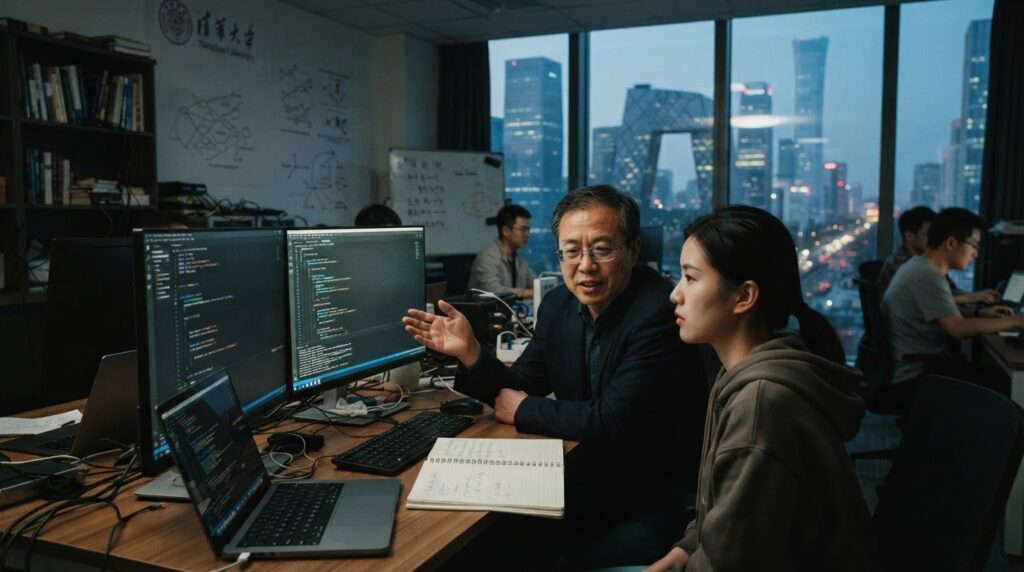
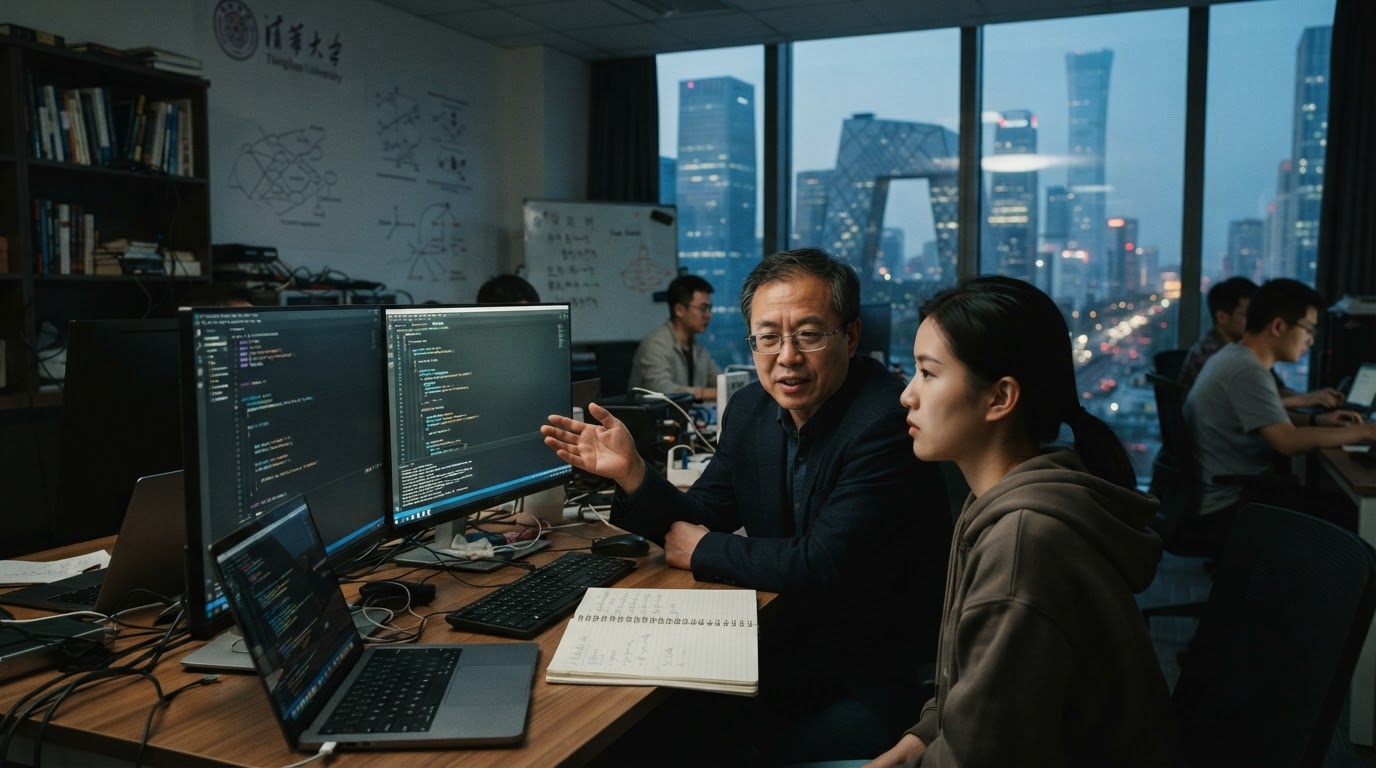
A university lab nurtured the scientists behind both Z.AI and Moonshot AI. Tang was among Chinese AI experts already working at the frontier of language understanding and face recognition more than a decade ago — before GPT-3 existed, before “foundation model” was a phrase anyone used. When OpenAI released GPT-3 in 2020, Tang’s team at Z.AI set a clear goal: build something just as good. In our read of the sourcing, that wasn’t a reactive scramble. It was a team that had been training for the race and finally saw the finish line marked.
Yang’s trajectory tells a similar story. He didn’t stay in the U.S. after Carnegie Mellon. He came back, helped his former professor’s research, then spun out on his own. Moonshot AI’s flagship product, Kimi, has become one of the most-used AI assistants in China — and increasingly beyond it.
Why Z.AI and Kimi are worth watching now
Here’s the part that should matter to operators building on or alongside AI platforms.
Both Z.AI and Moonshot AI are not just capability plays. They are monetization plays. One summary from the sourcing put it plainly: “They know perfectly how to monetize their work.” That’s a pointed observation. Plenty of labs can build impressive models. Fewer can turn frontier research into products people pay for at scale.
Kimi, in particular, has moved fast on the product layer — long-context handling, multimodal features, and a consumer interface that competes directly with ChatGPT in usability. Z.AI has pushed hard on global usage, not just domestic. Both companies are, in practice, testing whether the next phase of the AI race is won on research benchmarks or on distribution and product velocity.
Meanwhile, the questions Washington and Silicon Valley are asking — are they stealing models, should their products be banned — are legitimate. But they are also, in part, a distraction from the structural reality: China built a deep bench of AI talent inside its universities, and that bench is now shipping products.
The lesson that travels
There’s a version of this story that reads as a geopolitical thriller. But the version that’s actually useful is simpler. Tang Jie spent 25 years on a problem. He trained people who went on to build companies of their own. The compounding was slow, then sudden — which is typically how compounding works.
For anyone building in the AI space right now, the Z.AI and Moonshot AI story is a useful reminder: the competitors worth watching are rarely the ones who appeared last quarter. They’re the ones who’ve been in the lab for a decade, waiting for the moment the market caught up to their obsession.
Tang saw himself as competing with Sam Altman long before most people knew who Sam Altman was.
One thing to do this week: Pull up Kimi and run a task you’d normally send to ChatGPT or Claude. Not to switch — but to calibrate. You should have a direct read on where the gap is, and whether it’s closing, before someone else forms your opinion for you.
Eagentix helps growth-focused enterprises transform manual, time-consuming business processes into fast, dependable automated operations. By combining executive strategy with tailored smart automation, we empower companies across Southeast Asia to scale productivity, ensure regulatory compliance, and reduce operational costs by up to 70%.