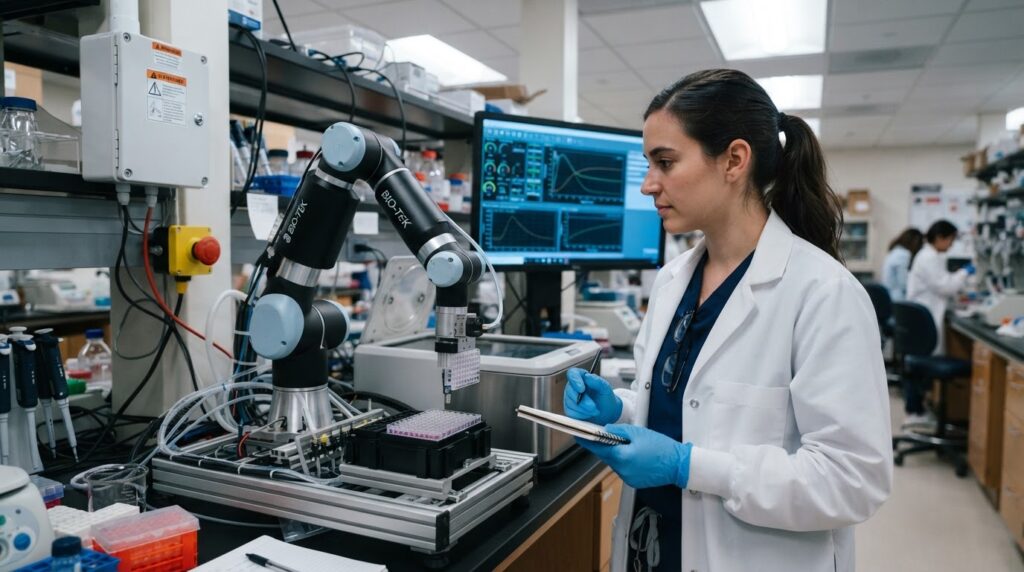
The moment agentic AI left the screen
For the past two years, AI agents have been remarkably good at one thing: manipulating symbols. Text, code, images, API calls — all of it stays inside a computer. On August 27, 2026, Anthropic drew a line under that era. The Model Hardware Standard (MHS) is a specification that lets AI agents read sensors, write to actuators, and operate physical equipment through a single, standardised interface. CNBC called it Anthropic pushing into the physical world. That framing is accurate — but the more precise story is about infrastructure, not ambition.
Here are the five developments inside the announcement that operators should actually track.
1. MHS is a protocol, not a product
MHS defines read and write primitives for sensors and actuators — the lowest-level language physical devices understand. Enterprise DNA’s breakdown is precise on this: it is not a high-level API. It is a protocol layer that converts complex, proprietary device drivers into standardised commands any AI agent can issue.
Why does that distinction matter? Because it means the integration work moves down the stack. A lab technician today writes custom glue code for every new instrument. With MHS, the instrument exposes a standard interface and the agent handles the rest. Anthropic says early testing with scientific partners reduced device integration time and made it possible to iterate faster across experimental settings — though the company has not published a precise benchmark figure.
2. Safety is enforced below the agent, not above it
This is the design decision that separates MHS from a naive “let Claude drive the robot arm” integration. Safety limits are baked into the driver layer, not delegated to the model’s judgment. The specification includes constraints that block operations before machinery moves: collision prevention during robotic arm transfers, laser power caps that protect samples, detection of missing or rotated plates, and emergency-stop triggers on anomaly detection.
The agent cannot instruct a laser to exceed its safe power ceiling. The driver refuses the command. That is a meaningful architectural choice — and a credible answer to the obvious objection that language models hallucinate and should not control physical systems. The model’s reasoning layer sits above a hard constraint layer it cannot override. Safety is, as Enterprise DNA notes, baked into the protocol rather than bolted on as an afterthought.
3. A tagging system bridges the virtual-physical gap
Most frontier models were trained almost entirely on digital data. They have no intuition for the weight of a robot arm, the range of a linear actuator, or the torque limits of a stepper motor. MHS addresses this with a standardised tagging system that encodes physical characteristics — weight, range, adjustable parameters, measurement options, and enforced safety limits — into a reference file the model can read before it issues any command.
In practice, this means an agent encountering a device it has never seen can still operate it safely — provided the manufacturer has tagged it correctly. That “provided” carries real operational weight. Tag quality will vary across manufacturers, and auditing tags becomes a new operational responsibility for any team deploying MHS. It is the kind of controls function most hardware teams have not yet scoped.
4. The partner cohort signals the intended trajectory
MHS launched in research preview with AWS (Strands Robots), Hugging Face (LeRobot), Raspberry Pi, Automata, and Universal Robots, developed alongside HHMI Janelia Research Campus. Anthropic’s announcement frames these partners as helping build safety evaluations and best practices — not just as early adopters.
Read the list carefully. Raspberry Pi signals consumer and hobbyist hardware. Universal Robots signals industrial automation. Hugging Face signals the open-source model community. Together, they sketch a roadmap from research lab to factory floor to maker bench. Anthropic is explicitly not positioning MHS as a Claude-only advantage. The specification is model-agnostic by design, and open-sourcing is planned after the preview period concludes.
5. The MCP playbook is running again
Anthropic open-sourced the Model Context Protocol in late 2024, and it became the de facto standard for connecting AI agents to software tools across the industry. Coursiv’s analysis frames MHS as the same strategic play aimed at the physical world — launch with heavyweight partners, open-source after safety validation, let the ecosystem do the adoption work.
But the physical world is harder than the software world. A buggy MCP integration breaks a workflow. A buggy MHS integration can break equipment — or injure someone. That asymmetry is why the preview period exists, and why the safety-at-the-driver-layer architecture is not just a feature but a prerequisite for broad adoption.
What this means across the five developments
Taken together, these five pieces tell a coherent story. MHS is an infrastructure bet, not a product launch. Anthropic is trying to set the standard interface between AI and physical systems before the market fragments into proprietary integrations — the same move it made with MCP, and before that, the same move USB-C made for hardware connectivity. Elizabeth Kelly, Anthropic’s head of beneficial deployments, told CNBC: “We built this for science to sort of show the promise of AI, but there’s also huge benefits here for enterprise and for industry.”
The strongest counterpoint is timeline risk. MHS is currently in research preview with a select cohort. Open-sourcing is planned but not yet dated. Safety evaluations are ongoing. Operators building physical automation today cannot assume MHS will be production-ready on any particular schedule — and betting a manufacturing workflow on a preview-stage specification carries real project risk. The right posture is to watch the safety evaluation outputs from preview partners before committing architecture decisions.
Meanwhile, the operators who engage with the specification now — even before it is open-sourced — will be better positioned to influence how device tagging standards evolve and which safety primitives become defaults. That is where the leverage sits at this stage.
Your one action this week: Convene your hardware integration team and map your current device driver inventory against the MHS tagging model described in Anthropic’s announcement — identifying which instruments and actuators expose programmable interfaces, which physical parameters would need to be encoded as tags, and which safety limits currently live only in operator procedure rather than driver logic. That audit will surface the gaps you need to close before the open-source specification drops, and it will give you a concrete basis for engaging the preview partner ecosystem on tag quality standards.
— Eagentix
Eagentix helps growth-focused enterprises redesign and automate manual business processes. We combine executive strategy, implementation support, and managed services to build dependable operations across Southeast Asia.