The measurement model you inherited was built for a different internet
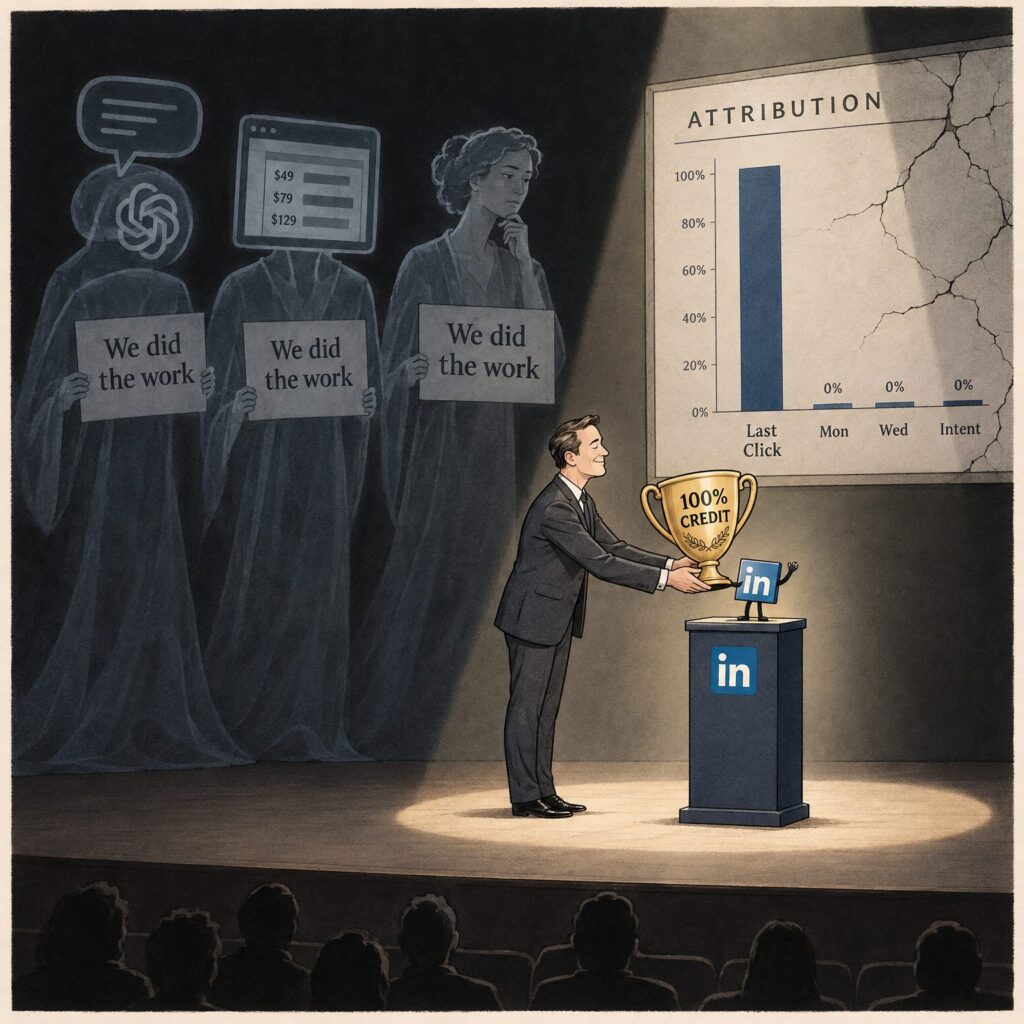
A prospect asks ChatGPT about project management software on Monday. They return Wednesday to compare pricing tiers. On Friday they click a retargeting ad on LinkedIn and convert. Your attribution dashboard awards 100% of the credit to that LinkedIn click. The Monday and Wednesday sessions — the interactions that built purchase intent — register as nothing.
That is not a measurement nuance. It is a structural flaw embedded in your reporting stack.
OpenAI began testing ads inside ChatGPT on January 16, 2026. adventuremedia.ai Most marketing teams responded by reaching for the tool they already had: last-click attribution. It was a poor fit before ChatGPT existed. On a conversational AI platform, it actively distorts budget decisions.
Why last-click was always a compromise — and why ChatGPT makes it untenable
Last-click attribution assigns 100% of conversion credit to the final touchpoint and ignores every interaction that preceded it. Triple Whale For years, marketers accepted this because stitching together a full cross-channel journey was technically difficult. They optimised for what they could measure.
The costs were documented before ChatGPT entered the picture. Search Engine Journal noted that using last-click with automated bid management “will eliminate upper-funnel activity and eventually reduce the number of new customer acquisitions driven by PPC ads.” Search Engine Journal Siteimprove observed that last-click “obscures where the search originated from, and the multiple steps taken by the prospect before they made a purchase.” Siteimprove Most teams knew this and tolerated it anyway.
ChatGPT removes the tolerance option. A single session on the platform can generate multiple brand exposures at different depths of the funnel — awareness, consideration and intent can all occur within one conversation. adventuremedia.ai There is no clean click path to attribute. As taggrs.io states: “ChatGPT doesn’t fit into last-click or even most data-driven attribution models built around clean click paths.” taggrs.io
The compromise that was tolerable on search becomes, on conversational AI, a mechanism for systematically defunding the campaigns doing the most work.
What first-click attribution actually reveals
First-click attribution assigns 100% of credit to the initial brand touchpoint. Emotive That sounds like the mirror-image flaw — overweighting awareness, ignoring conversion. For a pure conversion-optimisation task, it is. But for measuring whether ChatGPT ad spend is initiating genuine purchase journeys, first-click surfaces a signal that last-click buries entirely.
The question first-click answers is: which channel introduced this customer to the brand? On ChatGPT, where a user may see an ad, gain clarity during the conversation, and convert through a separate channel days later, that introduction moment is the value you need to capture. atozadvert.com Without it, you are optimising the last mile while defunding the activity that generates the journey.
Syed Zulqarnain, in a thread on Neil Patel’s LinkedIn post, identified the operational consequence directly: “When you track only last-click, you kill campaigns that actually warm up buyers over time.” LinkedIn Budget algorithms fed last-click data will defund upper-funnel ChatGPT placements because those placements never appear to convert — even when they are the reason conversions happen elsewhere.
The counterpoint worth taking seriously
The strongest objection to first-click is that it overcorrects. Awareness credit without conversion accountability produces campaigns with high reach and unclear return. That objection is legitimate. First-click tells you the journey started; it does not tell you whether it ended in revenue. Necessary information — but not sufficient for budget decisions.
The more defensible position is not “switch to first-click” but “stop relying on any single-touch model.” Position-based attribution — which assigns 40% credit to both the first and last touchpoints and distributes the remaining 20% across intermediate interactions — is a more structurally honest framework for multi-exposure journeys. Cometly adventuremedia.ai, citing UK attribution firm Ruler Analytics, reports that 75% of marketers have already moved toward multi-touch models. adventuremedia.ai The quarter still running single-touch are the most exposed on ChatGPT.
But even multi-touch models face a harder problem on conversational AI: session-level data from ChatGPT does not map cleanly to the cross-channel identifiers that existing attribution stacks were built around. taggrs.io That is an infrastructure problem, not a settings problem. Reconfiguring a dropdown does not solve it.
Three operational decisions to make now
Audit your attribution setting before your first ChatGPT campaign goes live. AppsFlyer data suggests 75% of companies still use single-touch models. AppsFlyer An optimisation algorithm trained on last-click data will actively penalise the placements doing the most awareness work. Change the setting before data accumulates, not after — retraining a bid algorithm on corrupted signal typically takes weeks.
Run first-click and last-click views in parallel, even if you do not optimise to first-click. The gap between what each model credits is a direct measure of how much upper-funnel influence your primary model is erasing. A large gap indicates budget is being quietly redirected away from the touchpoints that initiate purchase intent.
Treat ChatGPT attribution as a separate measurement workstream, not an extension of existing PPC reporting. The conversational journey — one session, multiple funnel stages, conversion on a different channel days later — requires session-level thinking. Digital Applied That means purpose-built infrastructure, not a bolt-on to a framework designed for keyword clicks.
Teams that build the measurement architecture now will be able to tell the board what ChatGPT advertising is actually worth. Teams that don’t will be arguing over which click to blame.
— Abhijit Ghosh
Eagentix helps growth-focused enterprises redesign and automate manual business processes. We combine executive strategy, implementation support, and managed services to build dependable operations across Southeast Asia.
Eagentix helps growth-focused enterprises redesign and automate manual business processes. We combine executive strategy, implementation support, and managed services to build dependable operations across Southeast Asia.
Sources
- – ChatGPT Ads Attribution: Tracking the Customer Journey in 2026
- – Why Last-Click Attribution Is Killing Your PPC Performance
- – ChatGPT Ads measurement explained
- – ChatGPT Ads Explained: How Brands and Marketers …
- – First Click Attribution: What It Is and When to Use It | Emotive
- – Last-Click Attribution: Definition, Pros & Cons | Triple Whale
- – What is last click attribution? | AppsFlyer mobile glossary
- – Is last-click attribution damaging your Ads performance?
- – What to Do When Last-Touch Attribution Fails on ChatGPT Ads
- – Why Your Ads Are Failing: The Truth About Last-Click Attribution | Neil Patel posted on the topic | LinkedIn
- – First Click vs Last Click Attribution: Which Model Works?
- – ChatGPT Ads Attribution: How Tracking Works Without
- – I need help fully understanding last-click, first- …
- – Why First-Touch and Last-Touch Attribution Are Outdated | AdRoll
- – First Click vs. Last Click in Google Analytics | by Kapil Bhatia
- – First Touch vs Last Touch Attribution: Choosing the Right Model
- – ChatGPT Ads Attribution: A Measurement Playbook 2026