A measurable performance gap, not a forecast
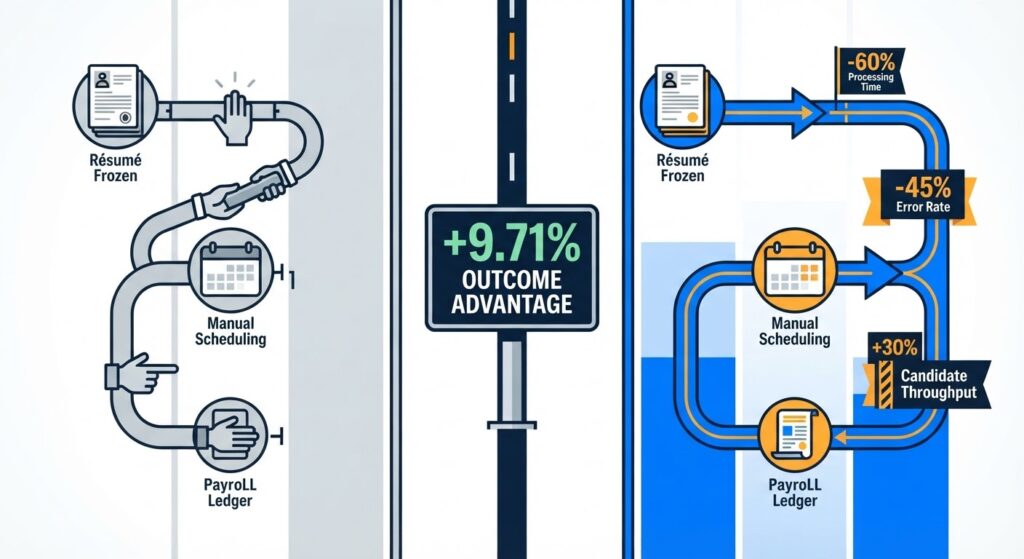
Organizations using AI and machine learning in their HR systems achieved a 9.71% higher average across HR, talent, and business outcomes compared to those that did not, according to the 2024–2025 HR Systems Survey cited by Cygnet (May 2026). That gap is already in the data — it is not a projection.
The gap exists because agentic HRMS operates on a structurally different model. Traditional platforms store and display data; humans interpret it, decide what to do, and act. Agentic systems do all three — continuously, without waiting to be prompted.
As the HRMindMap OS editorial team describes it: “Traditional HR software is reactive — it requires human-initiated actions at every step. Agentic AI for HR is proactive and autonomous: AI agents continuously monitor data streams, detect patterns, reason about the right action, and execute — from sending retention offers to at-risk employees to auto-filing tax forms. The difference is between a system you operate and one that operates for you.”
What the sourced measurements show
Three operational benchmarks from the Strategy&/PwC Global People Process Framework Analysis (November 2025) define the current performance envelope. These are scenario-level figures, not guaranteed outcomes, but they indicate the direction and order of magnitude.
Time-to-hire: up to 60% reduction. Autonomous résumé screening and interview scheduling compress a process that typically spans weeks into days. The agent does not wait for a recruiter to open the queue.
Payroll errors: approximately 45% decrease. Payroll is rule-dense and repetitive — exactly the terrain where autonomous execution outperforms human-in-the-loop review at scale. Compliance and employee satisfaction both improve as a result.
Talent-retention predictions: approximately 30% improvement. The agent correlates engagement signals, performance trends, and compensation data continuously rather than quarterly. A retention offer can reach an at-risk employee before they have accepted another role.
The same source reports up to a 30% reduction in administrative HR costs and 200% faster response times on employee queries.
Separately, OrangeHRM (December 2025) cites industry data suggesting AI integration in HR processes could reduce time spent on administrative tasks by half, with a projected 40% increase in AI adoption across HR workflows.
What changed between 2023 and 2026
AI adoption in HR climbed from 19% in 2023 to 61% in 2025, per Gartner figures cited by Kore.ai (November 2025). That is a category crossing a threshold in roughly 24 months, not incremental uptake.
Three technology shifts converged to make it possible, according to HRMindMap OS (June 2026): large language models reaching genuine reasoning capability, deep HRIS integrations becoming production-ready, and enterprise-scale deployment infrastructure maturing. Remove any one of the three and you have a demo, not a deployable system.
The practical result is a new architecture. An agentic HRMS can pursue a standing goal — ‘maintain a fully-staffed engineering team’ — by autonomously monitoring headcount, sourcing candidates, screening applications, scheduling interviews, extending offers, and reporting outcomes, with no human prompt at each step. That is categorically different from an RPA workflow or a chatbot that responds only when asked.
Where the contrast is sharpest — and where it breaks down
Legacy HRMS, HR chatbots, and RPA each occupy a distinct capability tier. Traditional HRIS platforms store and display — humans act. Chatbots respond when prompted — no proactive action. RPA automates rigid, rule-based sequences but cannot reason or adapt when conditions change. Agentic AI does all three and adds the ability to re-plan mid-execution, per the HRMindMap OS taxonomy (June 2026).
The contrast matters most in high-frequency, high-stakes workflows: payroll compliance, offer management, and onboarding sequences where a missed step carries legal or financial consequences. Those are the workflows where the 45% error-reduction figure becomes material.
The strongest counterpoint deserves a direct answer. Autonomous execution at this level requires clean, integrated data. Organizations with fragmented HRIS infrastructure — multiple disconnected systems, inconsistent employee records — will not realize these benchmarks without first resolving the data layer. A lower capture rate lowers return; that is a real constraint, not an objection to be reframed away. Agentic technology amplifies existing data quality; it does not substitute for data governance.
Implications for founders and executives
The demand signal from HR leadership is already confirmed. According to Strategy&/PwC (November 2025), 87% of CHROs are actively seeking new ways to deliver HR services more efficiently; 75% plan to invest in automation and AI tools within the next 12 months; 65% plan to increase digital HR technology investment specifically for cost savings.
That is a procurement wave with confirmed budget, not a research project. The performance gap between agentic and legacy infrastructure is measurable now.
Dr. Jagreet Kaur at XenonStack (January 2026) frames the organizational shift precisely: “Integrating Agentic AI into human resources represents a fundamental transformation rather than a simple technological upgrade. By combining AI’s analytical power and consistency with human HR professionals’ empathy and judgment, organisations can create intelligent HR functions that deliver unprecedented value.”
In practice, the HR function bifurcates. Routine and semi-complex decisions — screening, scheduling, compliance filing, onboarding sequences — move to autonomous execution. Strategic decisions, edge cases, and anything requiring empathy or cultural judgment stay with people. That is a reallocation of where HR professionals’ time creates value, not a reduction in their role.
Three decisions that follow from the evidence
Audit your current HRIS data quality and integration coverage before evaluating agentic vendors. The benchmarks above assume a clean, connected data layer; fragmented records will suppress results proportionally.
Prioritize the workflows where your error rates and cycle times are currently highest. Payroll compliance and offer management are where the 45% and 60% figures are most likely to be reproducible — and where the cost of a missed step is already quantifiable.
Evaluate vendor maturity against three criteria: LLM reasoning depth, HRIS integration breadth, and enterprise deployment track record. Feature lists and demo performance are insufficient proxies for any of the three.
The 9.71% outcome gap is already in the data. The data-readiness question is what determines which side of it your organization sits on.
— Abhijit Ghosh
Eagentix helps growth-focused enterprises redesign and automate manual business processes. We combine executive strategy, implementation support, and managed services to build dependable operations across Southeast Asia.
Sources
- – Navigating Top HR Trends for 2026 with Precision | OrangeHRM
- – Agentic AI in HR: use cases and real-world examples
- – Agentic AI in HR | Strategy&
- – AI Agents for HR: 12 Use Cases & Benefits
- – Agentic AI for HR: The Complete 2026 Guide | HRMindMap OS
- – Agentic AI in HR: Benefits, Use Cases, Next Steps
- – Streamlining Human Resources with Agentic AI and Agents
- – AI in HR: Moving Beyond the Hype to Actual Productivity
- – 6 HR Technology Trends 2026 | Maximize Employee Engagement
- – Unlocking AI Value in HR and the Enterprise | Gartner
- – AI Agents vs. Agentic AI: The Key Differences | Workday US
- – How Agentic AI Is Transforming HR Functions | Gloat
- – How Agentic AI Enhances Top HR Service Delivery Software
- – Agentic AI for HR: Automate Work and Save Time
- – Best AI Tools for HR Task Management in 2026: Agentic Automation Guide
- – Agentic AI in HR: Beyond Traditional Automation
- – AI Agents for HR: A Practical Guide to Agentic AI Across the Talent Lifecycle
- – Best HR Automation Solutions for 2026
- – Agentic AI in HR: 6 workflows for employee experience
- – Agentic HR with Workday: AI-Driven Workforce Management | Negits Solutions posted on the topic | LinkedIn
- – What Are Agentic Workflows? | NetSuite
- – Agentic AI for HR. Transform Your HR Functions with AI
- – What are Agentic Workflows? AI-Driven Automation for Complex Goals