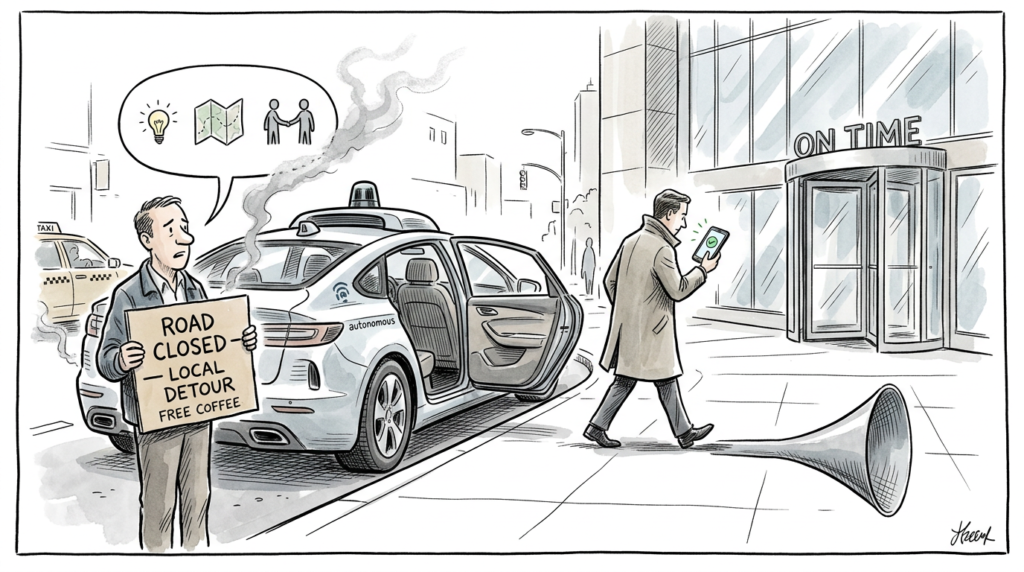
You feel the relief. You don’t feel what you lost.
Daniel Hook, Chief Scientific Officer at Holtzbrinck Group, named it precisely. Riding a Waymo gets you to your destination faster. But you skip the driver who mentions a road closure you didn’t know to ask about. You skip the small talk that turns into a useful connection. You arrive on time and slightly less informed than you might have been. Hook’s argument, published in Research Agenda in September 2026, is that always-available AI colleagues are doing the same thing to knowledge work — at scale, invisibly, and with institutional incentives pushing everyone in the same direction. Hook’s essay, republished via Wonkhe, is worth reading in full. The operational question is sharper: what should leaders actually do about it?
Peter Steinberger amplified the thesis on X. Gabriele Labanca, writing on LinkedIn, gave the dynamic a name: decollaboration. Labanca’s framing is the sharpest version of the argument: “The collaborator’s inconvenience is not a bug in the collaboration; it largely is the collaboration. The value of another mind lies exactly in the ways it refuses to be an extension of your own.”
Friction was doing hidden work
Hook’s core observation is asymmetric visibility. The costs of human collaboration — the scheduling, the argument about author order, the colleague who tells you you’re solving the wrong problem — are always legible. You feel them. The benefits of that same friction are mostly invisible until they’re gone. So when an LLM removes the friction, the ledger looks one-sided. Output goes up. Irritation goes down. The organisation declares a win.
But something else was happening in those difficult exchanges. The team-science literature, cited in Hook’s essay, finds that small, atypically paired teams — collaborators from different fields and institutions — disproportionately produce the most novel work. Large teams develop; small, unexpected combinations disrupt. Hook notes that early evidence on generative AI points toward individual productivity rising while the diversity of ideas narrows — “everyone moving faster along increasingly similar paths.”
Writing is thinking. Hook makes this explicit: the two are not separable activities that happen to occur in sequence. When an AI drafts your literature review or your first-pass memo, you skip the cognitive work that would have forced you to notice the gap in your own reasoning. You get the output without the understanding it was supposed to build.
Hook’s summary is worth quoting directly: “Remove the difficulty for the sake of comfort, and you do not get the same understanding faster. You get less of it, delivered more smoothly.”
The strongest counterpoint deserves a real answer
Friction has always been unevenly distributed. Junior researchers at under-resourced institutions, teams without access to well-connected networks, individuals who face social barriers in the conference-bar conversations Hook describes — these groups never had full access to the serendipity being mourned. AI tools can democratise individual capability in ways that human collaboration networks historically have not.
That objection is legitimate. It doesn’t dissolve the Waymo effect; it redirects it. If AI levels access to individual capability while simultaneously reducing the cross-institutional, cross-disciplinary encounters that generate genuinely novel ideas, the net result could be a flatter distribution of competent output and a sharper decline in breakthrough work — more people producing better average results, fewer producing the outliers that move a field. That trade-off is worth naming before you make it.
The incentive structure is the deeper problem. Hook is explicit: academic and organisational reward systems currently favour rapid, solitary output over slower, costlier human partnership. AI didn’t create that misalignment. It accelerates it — and makes the consequences harder to reverse once they’re embedded in how people habitually work.
What operators should actually do
Hook’s recommendation to research leaders is direct: deliberately fund the friction. Workshops, site visits, co-location, cross-institutional pairings — these are not perks or morale investments. They are a structural counterweight to the efficiency gains your AI tools are already delivering. If your organisation is capturing throughput on one side of the ledger, it needs to budget for serendipity on the other.
Three operational decisions follow from taking the Waymo effect seriously.
Audit where AI has replaced human exchange, not just human effort. A literature review drafted by an LLM saves time. It also removes the conversation with a colleague who would have pointed you toward a paper you didn’t know to search for. The question isn’t whether the output is good enough — it often is. The question is what the process was building that the output alone cannot replace.
Protect asynchronous friction as deliberately as you protect synchronous efficiency. Not every meeting needs to become a prompt. Some of the most durable organisational knowledge lives in the back-and-forth of a difficult email thread, the pushback in a document comment, the argument that forces someone to articulate why they believe what they believe. Those exchanges are the apprenticeship layer of any knowledge organisation. Routing them to a chatbot, as Labanca puts it, quietly withdraws threads from the fabric — and no individual thread’s absence is visible until the fabric tears.
Revisit your performance metrics. Output volume rising since broad AI adoption is a real signal. But it is not the only one worth tracking. Are cross-team collaborations increasing or declining? Are junior staff developing the reasoning skills that show up in their independent work two years later, or are they becoming fluent at prompting without becoming fluent at thinking? Those are slower signals, but they determine whether your organisation is building durable capability or consuming it.
The one action this issue asks for
Before your next planning cycle, map one workflow where AI has replaced a human exchange — not human effort, but human exchange. Decide deliberately whether that replacement was worth it, and what you would need to fund to restore the serendipity it removed. That audit forces the conversation your incentive structure is currently rewarding you to skip.
— Eagentix
Eagentix helps growth-focused enterprises redesign and automate manual business processes. We combine executive strategy, implementation support, and managed services to build dependable operations across Southeast Asia.
Sources
- Source: Everything That Happened in AI Today (Thurs, October 1 2026) | The Neuron (
- Source: OpenAI Lost 3 Safety Researchers — And 100 Other AI Stories You Might’ve Missed | The Neuron (@theneurondaily) on X (
- Source: Waymo Effect: AI Reduces Research Collaboration | Pascal Finette posted on the topic | LinkedIn (
- Source: The Waymo effect: how AI is quietly making research less collaborative | Gabriele Labanca (
- Source: Frictionless tech erodes research collaboration value | Jim Dickinson posted on the topic | LinkedIn (
- Source: The Waymo effect: how AI is quietly making research less collaborative – Wonkhe (