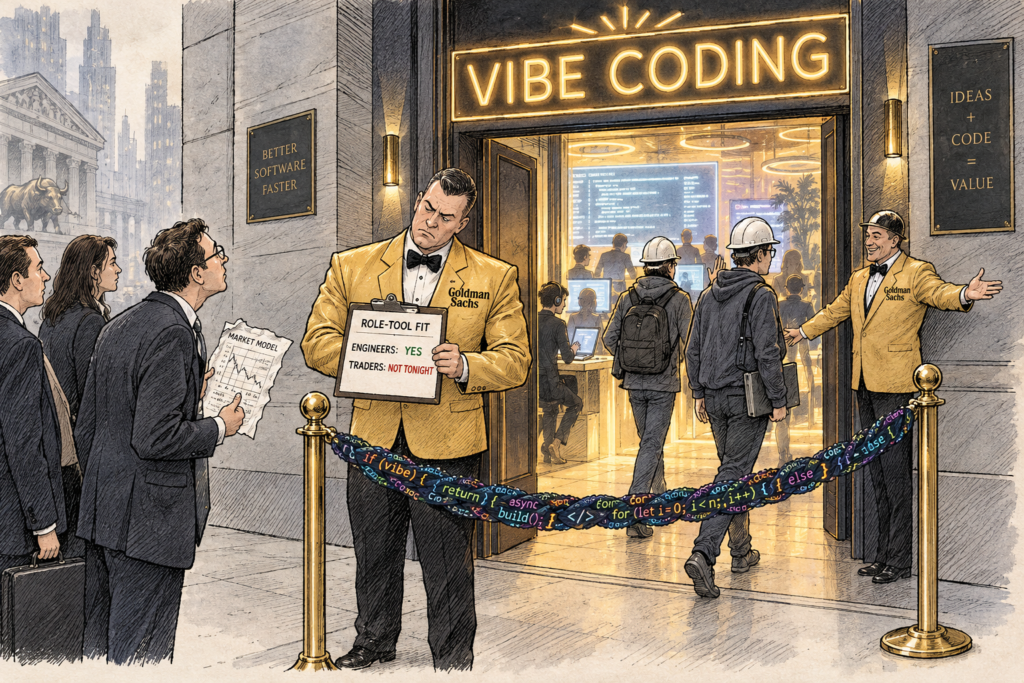
The bank that praised “vibe coding” just narrowed who can use it
Earlier this year, Goldman Sachs CIO Marco Argenti was publicly endorsing “vibe coding” — the idea that non-technical staff could use AI coding assistants to get real work done. Traders were using Anthropic’s Claude Code and Microsoft’s GitHub Copilot to monitor client trading flows, build market models and generate content. The bank had deployed the tools broadly and, for a while, seemed satisfied with the results.
Then October arrived. Under updated internal guidelines, Goldman restricted access to Claude Code and GitHub Copilot to its roughly 12,000 engineers. Bankers and traders who had relied on those tools for months found the door partly closed. A Goldman spokesperson framed it plainly: the firm put the tools “in the hands of those who are best suited to leverage them for the long term.”
That is a careful sentence. It does not say the tools failed. It says the fit was wrong.
What the trial period actually revealed
A Goldman spokesperson confirmed the adjustments came after a trial period that weighed efficiency gains against risks and controls. The bank did not announce a failure. But the outcome — restricting access by job function rather than geography — tells you something about what the trial found.
Coding assistants are built for a specific workflow: write code, get a suggestion, evaluate it, commit or discard. That loop works because the engineer applying it has the context to judge the output. When a trader uses the same tool to model a position or summarise a client flow, the judgment layer changes. The trader may lack the technical frame to catch a plausible-sounding but structurally wrong output. In a regulated trading environment, that gap is not a nuisance — it is a control failure waiting to happen.
Goldman’s move is less about AI being dangerous and more about role-tool fit. Quant strategists — Goldman’s “strats” group, who combine software engineering with quantitative work — kept their access. That carve-out confirms the logic: if your role includes programming as a core function, the tool belongs. If it does not, the risk-benefit calculation shifts.
A pattern of tightening, not a one-off
Goldman’s October guidelines were not the first tightening in 2026. In April, the bank restricted Claude access for Hong Kong-based bankers following a contract review. That move was location-specific. The October move is function-specific. The direction of travel is consistent: narrower access, clearer criteria, tighter accountability for which roles can operate which tools.
Goldman is not operating in isolation either. Bank of America placed limits on AI agents’ access to consumer deposits while developing liability protocols, and Citigroup blocked third-party agents from logging into accounts or transacting. The financial sector is collectively working out where AI autonomy ends and human accountability begins. Goldman’s restriction is one data point in that broader recalibration.
Meanwhile, Goldman continues rolling out its in-house GS AI Assistant to approximately 46,000 employees and is testing agentic AI for trade surveillance and other operations. Employees outside engineering who relied on Claude or GitHub can request alternative tools or use the GS AI Assistant instead. The bank is not retreating from AI. It is redirecting it.
The counterpoint worth taking seriously
The strongest objection to Goldman’s approach is that it slows capability diffusion. Traders who built genuine productivity habits around Claude Code now face friction. Some will adapt to the GS AI Assistant. Others will simply work without the capability. In a competitive market where speed and analytical depth matter, that friction has a real cost — and it falls unevenly on the people who were most proactive about learning the tools.
That objection is fair. But it conflates adoption speed with appropriate adoption. A tool that produces an undetected error in a trading model is not a productivity gain — it is a liability. The question Goldman appears to have answered is: who has the judgment to catch the tool’s mistakes? For coding assistants, that is engineers. For non-technical workflows, a different tool — purpose-built for that context — is probably the right answer. The friction is real; so is the risk it is designed to prevent.
What operators should do with this
Goldman’s decision offers a replicable framework. Three implications follow for any organisation running a broad AI deployment.
Tool access should follow role context, not seniority or enthusiasm. The question is not whether a person is capable of using an AI tool — it is whether their role gives them the judgment to evaluate its outputs in a consequential setting. Coding assistants require coding context. Audit that fit explicitly before you deploy broadly.
A trial period only generates useful signal if you define the risk criteria before it starts. Goldman’s trial produced an actionable outcome because the bank was measuring efficiency gains against risks and controls — not just tracking usage volume. Build your evaluation criteria into the pilot design, not the post-mortem.
A purpose-built internal tool is a genuine alternative, not a consolation prize. Goldman’s GS AI Assistant rollout to approximately 46,000 employees suggests the bank believes a purpose-fitted internal tool can serve non-engineering staff better than a general-purpose coding assistant. If your organisation relies entirely on third-party tools, it is worth asking whether any of them were actually designed for your non-technical users’ workflows.
The concrete next step: map your current AI tool deployments against the job functions using them. For each pairing, ask whether that role includes the domain judgment needed to evaluate the tool’s outputs in a regulated or high-stakes setting. Where the answer is no, either restrict access or replace the tool with one built for that context. Goldman ran a months-long trial to reach that conclusion. The mapping exercise itself takes an afternoon.
— Eagentix
Eagentix helps growth-focused enterprises redesign and automate manual business processes. We combine executive strategy, implementation support, and managed services to build dependable operations across Southeast Asia.
Sources
- Goldman Sachs
- reported
- Claude Code
- GitHub
- Bank of America
- Citigroup
- drawn the same line
- Alexis Dufresne
- D
- View on Bluesky →
- Brokers
- More
- Source: Goldman Sachs Limits AI Tool Access to Engineers Only – Tech AI Magazine – The World’s Leading AI Magazine (
- Source: Goldman Sachs restricts traders from using certain AI tools (
- Source: Goldman Sachs Limits AI Coding Tools to Engineers | Wisevoter (
- Source: Goldman Sachs Restricts AI Coding Tools for Traders – AI Brief (
- Source: Goldman Sachs Bars Traders from AI Coding Tools Like Claude | Phemex News (
- Source: PYMNTS | Goldman Sachs Bars Bankers From Employing Some AI Tools (
- Source: Goldman Sachs Pulls Claude Code and GitHub Copilot From Traders and Bankers, Confines Access to 12,000 Engineers | AI Weekly (
- Source: Goldman Sachs bans traders and bankers from using some AI tools – report — TradingView News (
- Goldman Sachs [GS](