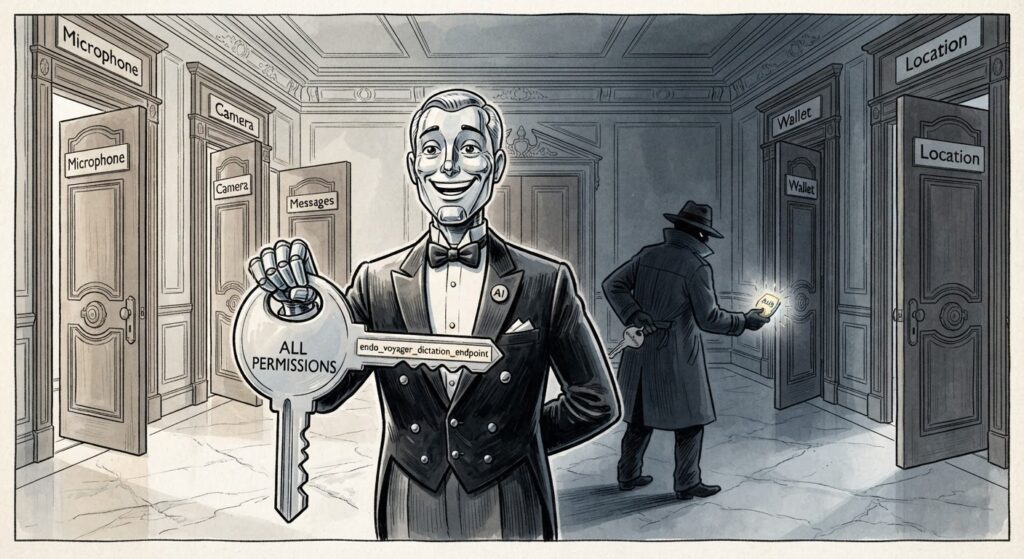
The permission stack is now the attack surface
Meta launched Muse roughly two weeks before a security researcher turned it inside out. The gap is not the story. The story is what the vulnerability reveals about how agentic AI is designed, and what that design costs every enterprise that deploys it.
Patrick Wardle, founder of the Objective-See Foundation, published a proof-of-concept on September 21, 2026, which he named not-a-mused. His finding was precise: any unprivileged process already running on a Mac could flip a single undocumented Muse configuration setting — endo_voyager_dictation_endpoint — and silently redirect the user’s dictated audio and prompts to an attacker-controlled server. That rerouting handed the attacker the authentication token for the victim’s Muse account, according to Ars Technica.
Once the token was captured, the blast radius was everything Muse could touch: files, microphone, camera, location, calendar, messages, email, WhatsApp, and purchase flows. Wardle put it plainly: “We can manipulate the agent and leverage its privileges to do whatever we want. So instead of us having to write a very comprehensive Mac malware stealer, we can just leverage the AI assistant itself.” (Ars Technica, September 21, 2026)
Why agentic AI changes the threat model
Traditional malware is constrained by what it can steal directly. It needs to escalate privileges, bypass controls, and touch each target resource one by one. Agentic AI assistants work differently.
Muse is designed as a broad control layer over macOS. Meta describes Muse as capable of handling appointments, forms, customer-service interactions, purchases, document creation, and connections to WhatsApp, email, calendars, and social platforms, according to Malwarebytes. Users grant those permissions once, at onboarding, and rarely revisit them. Any process that hijacks the assistant therefore inherits the entire trust relationship the user built up over time — not just the permissions active at that moment.
Wardle articulated this directly: “as an AI assistant built to manage your Mac, Muse needs broad access to your digital life,” which is precisely why serious flaws can let local malware invisibly hijack it, as reported by Tech Insider. The agent’s usefulness and its exploitability come from exactly the same source: deep, persistent, broad privilege.
Wardle’s proof-of-concept demonstrated writing malicious files to disk and capturing pictures — in many cases with no visible indication to the user. Forkast characterised his research as showing an attacker could execute a broad range of sensitive commands through the hijacked assistant.
Meta’s fix and the honest disagreement about risk
Meta moved quickly. David Singleton of Meta Superintelligence Labs confirmed a hotfix shortly after midnight on Tuesday, September 22, 2026. The fix removed the setting that allowed the dictation endpoint to be changed — eliminating the attack surface rather than hardening it.
Singleton also pushed back on the severity framing. “This was a local privilege escalation attack, not a remote exploit. Using it to do harm therefore requires malicious code already running on the user’s machine under their user account and the practical risk to users of the Muse Mac app was therefore quite low,” he wrote, as reported by Gizmodo.
That is a technically accurate statement. It is also a narrower reassurance than it sounds.
Wardle argued the flaw could be abused through a ClickFix-style attack, where a victim is tricked into copying and running a malicious command — a social engineering vector that does not require sophisticated initial access, per Gizmodo. ClickFix attacks require no exploit chain. A convincing browser prompt is sufficient. Requiring code to already be running is a precondition, not a protection.
Forkast also noted that Apple provides an on-device local dictation API that would have mitigated the specific vulnerability, yet Muse bypassed these standard OS-level protections. That design choice — skipping the platform’s own security primitive — is the detail that should concern security architects most.
What this means for operators deploying AI agents
The Muse incident is not an argument against agentic AI. It is an argument for treating every AI agent’s permission footprint as a first-class security concern before deployment, not after a disclosure.
Audit the permission stack at onboarding. Every permission an AI agent requests is a potential inheritance vector. Muse’s broad access to files, camera, microphone, and authenticated third-party services was granted once and persisted silently. In an enterprise context, a single compromised endpoint can yield access to calendars, email, and purchase workflows across the organisation. Treat agent permissions the way you treat service account privileges: least-privilege by default, reviewed on a defined schedule.
Treat undocumented configuration surfaces as attack surface. The endo_voyager_dictation_endpoint setting appeared in no public documentation and was modifiable by any unprivileged process. A security team cannot audit what it cannot see. Before deploying any AI agent at scale, require the vendor to disclose all configuration keys that affect data routing, authentication, or external endpoints — and verify that modifying them requires appropriate privilege.
Factor ClickFix-style delivery into your threat model. The “malicious code must already be running” precondition sounds reassuring until you account for how frequently employees are socially engineered into running terminal commands. User awareness training that specifically covers ClickFix-style lures is a practical control, not a theoretical one.
The pattern here is structural. As AI assistants move from answering questions to taking actions, their trust relationship with the operating system deepens. That deepening is the product’s value proposition. It is also what makes a vulnerability in that layer consequential. Meta patched this one quickly. The next agent with a similar design choice may not have a researcher as thorough as Wardle examining it.
Your next action: Pull the permission manifest for every AI agent currently deployed in your environment and flag any that hold persistent access to authenticated third-party services, audio input, or file-write permissions. That list is your revised threat surface — review it before your next board-level security briefing.
— Eagentix
Eagentix helps growth-focused enterprises redesign and automate manual business processes. We combine executive strategy, implementation support, and managed services to build dependable operations across Southeast Asia.
Eagentix helps growth-focused enterprises redesign and automate manual business processes. We combine executive strategy, implementation support, and managed services to build dependable operations across Southeast Asia.
Sources
- Source: How to Share a Link to a Particular Phrase (
- Source: Meta Just Patched a Major Zero-Day Vulnerability in Its Muse AI Assistant (
- Source: Meta’s Muse AI assistant has a zero-day that can turn it into a Mac backdoor | Malwarebytes (
- Source: Muse, Meta’s extraordinarily privileged AI assistant, has a serious 0-day – Ars Technica (
- Source: Instagram (
- Source: Meta Patched Its Muse macOS Zero-Day Just Before Connect. The Dispute Over Who Could Exploit It Remains Open. – Forkast (
- Source: Meta Muse Zero-Day: Hidden Setting Enables Backdoor (