The provenance problem boards are missing
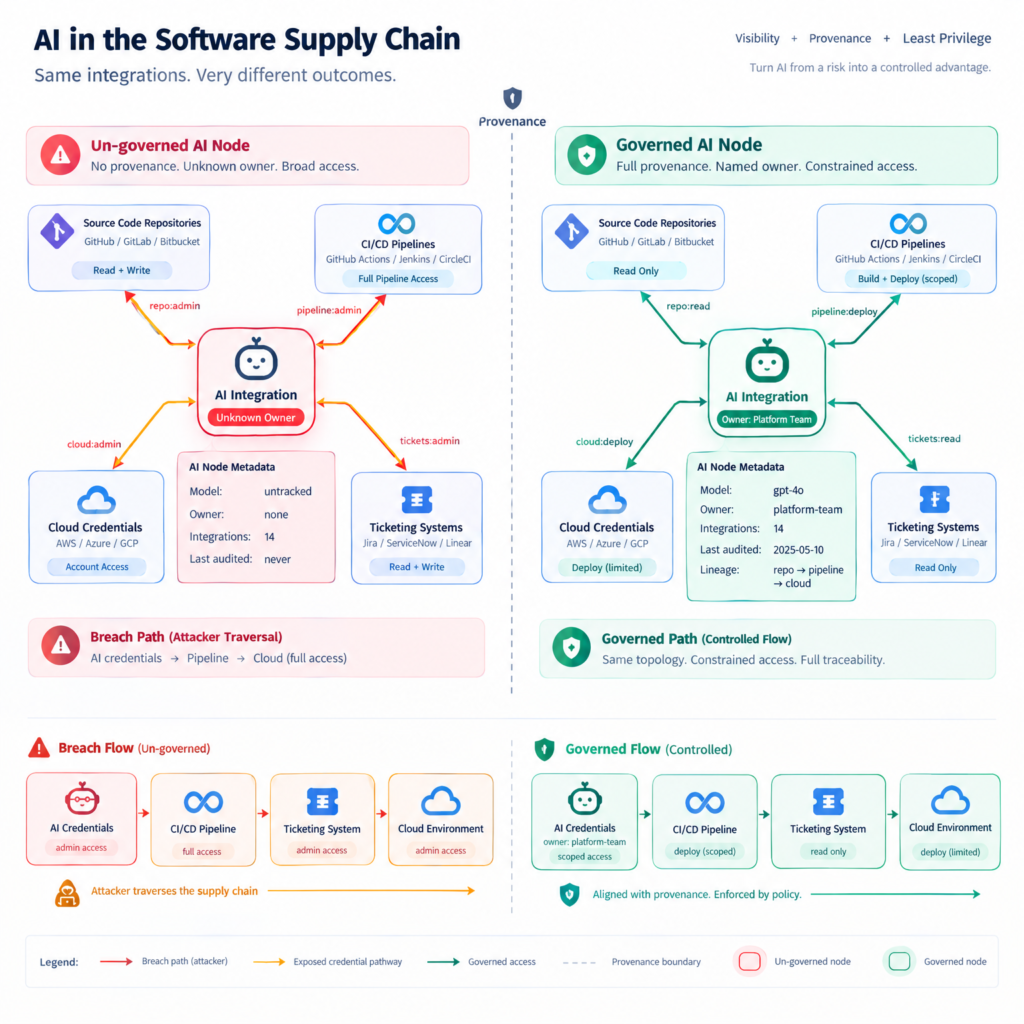
Nobody knows what’s in the stack. That is a security posture problem. While boards debate AI ethics, the operational failure is provenance: undocumented models, untracked integrations, and AI credentials carrying privileged access to source code, tickets, pipelines, and cloud environments at the same time. Cycode’s 2026 analysis is direct: compromised AI credentials, integrations, or agents can provide attackers with privileged entry points into multiple stages of the software supply chain. That is a supply chain breach, not an ethics breach.
The operational consequence of that framing is concrete. Treat an AI tool as a governed artifact — with lineage, access controls, and a named owner — and the remediation path becomes legible: inventory it, trace it, constrain it. Keep it as a black-box productivity layer and the attack surface grows silently with every new integration.
What the evidence shows
The gap between governance intent and operational discipline is wide and closing unevenly. The City of Lethbridge moved off manual spreadsheets onto Diligent ERM and compressed a four-year risk-maturity plan into under 12 months using interactive heat maps and dashboards. That outcome is about governance velocity, not technology novelty.
On the demand side, Mordor Intelligence (August 2026) reports that 93% of surveyed manufacturing plants plan to accelerate reshoring programs. Each reshored supplier node adds a new configuration surface and a new AI integration point. That pressure is arriving in procurement queues now, not in a future planning cycle.
Oracle announced four new Fusion Agentic Applications for Oracle Fusion Cloud SCM in June 2026, targeting inventory visibility and manufacturing efficiency. In October 2025, Oracle had already introduced AI agents within Oracle Fusion Cloud Applications aimed at improving supply chain performance. The direction is consistent: AI functionality is being bundled natively into subscription suites. Governance requirements that are not negotiated at the contract stage will not be retrofitted after deployment.
Three forces converging on the same pressure point
Regulatory scope. Diligent (June 2026) identifies the EU AI Act, NIST AI Risk Management Framework, and ISO/IEC 42001 as the active regulatory landscape as of mid-2026. These frameworks ask whether an organization can demonstrate lineage, access control, and documented decision constraints — the same questions a supply chain auditor asks about a critical component.
Fiduciary exposure. Per Diligent’s analysis, AI governance sits at the intersection of regulation, board fiduciary duty, enterprise risk exposure, and stakeholder trust, cutting across boards, risk, compliance, audit, legal, and business units simultaneously. Directors who cannot demonstrate oversight of AI systems in their stack face liability exposure comparable to directors who cannot account for a material supplier relationship.
The architecture gap. Rob Saker (February 2026) describes the required architecture as three layers: an open data foundation, a unified governance layer controlling access and lineage, and a composable processing layer for analytical and agentic workloads. The governance layer is precisely where uncontrolled access accumulates when enterprises deploy AI agents without a structured inventory.
“In practice, responsible AI is not an ethical posture but an operational discipline. It shows up in how decisions are constrained, how trade-offs are acknowledged, and how accountability is enforced when systems operate at scale.” — Executive Guide to Enterprise AI Governance and Risk Management, Appinventiv, January 2026 (author unattributed)
Where the failure mode is clearest: manufacturing and automotive
Supply Chain Management Review (November 2025) notes that supply chain leaders in manufacturing and automotive are shifting toward AI-first operations, but that true scalability requires clean data, standardized processes, and disciplined governance. Governance and data quality are prerequisites, not follow-on tasks — organizations that skip them face compounding problems as AI deployment scales.
The strongest counterpoint deserves a direct answer: many enterprises have captured genuine productivity gains from AI tools deployed without formal governance. That is accurate. But productivity gains and security posture measure different things. An AI agent with broad pipeline access that improves scheduling efficiency also introduces an undocumented privileged entry point. The efficiency gain is visible in the next reporting cycle. The access exposure accumulates silently until an incident makes it legible.
Alan Amling framed the deployment decision precisely in a Supply Chain Dive interview/email (July 2026): “The question is not ‘where can we use AI?’ It is ‘which decisions in our supply chain are made frequently, under time pressure, with data the organization can actually see?'” That is a governance question. Answer it without a documented access scope and you deploy into an uncontrolled surface.
Operator-level actions
Treat your AI inventory as your attack surface map. Every AI tool with access to code, pipelines, or operational data is a supply chain node. Document it, assign an owner, and audit its access scope. The EU AI Act, NIST AI RMF, and ISO/IEC 42001 all require demonstrable lineage and access control — the audit should produce a named list of tools, their integration points, and the data they can read or write, not a policy document asserting that governance exists.
Negotiate governance requirements at procurement. As vendors bundle AI agents natively into subscription suites, the access permissions those agents carry need to be a contract deliverable. Require documented lineage and access scope before signature. Discovering those permissions during an incident review is a materially worse position than negotiating them upfront — and it is increasingly the default outcome for organizations that treat governance as a post-procurement task.
Operationalize governance velocity. The City of Lethbridge compressed four years into twelve months by deploying governance tooling rather than extending a policy conversation. Enterprises that operationalize lineage tracking and policy automation before regulatory enforcement tightens will typically carry a measurable compliance and audit advantage. Enforcement timelines under the EU AI Act are scheduled, not speculative.
These actions do not apply equally to every organization. Early-stage companies with limited AI deployment and no EU AI Act exposure have more runway. Any enterprise operating AI agents across supply chain, finance, or operational data under EU AI Act jurisdiction should treat the governance layer as infrastructure with a cost of deferral, not overhead with an optional timeline.
— Abhijit Ghosh
Eagentix helps growth-focused enterprises redesign and automate manual business processes. We combine executive strategy, implementation support, and managed services to build dependable operations across Southeast Asia.
Eagentix helps growth-focused enterprises redesign and automate manual business processes. We combine executive strategy, implementation support, and managed services to build dependable operations across Southeast Asia.
Sources
- – Executive Guide to Enterprise AI Governance and Risk Management
- – AI governance: A guide for boards, risk and audit leaders
- – AI is Eating Enterprise SaaS. How AI is Dismantling Vertical SaaS… | by Rob Saker | Medium
- – How supply chain leaders can avoid common AI pitfalls
- – Software Supply Chain: The Complete Guide | Cycode
- – 2026: The age of the AI supply chain – Supply Chain Management Review
- – Why Enterprise AI Needs Deep Business Semantics | AI Data Platform
- – US Supply Chain Management Software Market Size & Share Analysis – 2031
- – Supply chain resilience isn’t a data problem; it’s a judgment problem – Supply Chain Management Review
- – Guest Post: AI Governance Is a Fiduciary Duty | The D&O Diary
- – AI Governance: Best Practices, Frameworks & Implementation
- – Enterprise AI Governance: What It Is and Why It Matters
- – The Governance Gap: What IDC’s 2026 Data Reveals About AI and the Software Supply Chain
- – Enterprise Ai Model Governance Software: Platform Guide
- – AI Governance Statistics 2026: Key Data & Insights
- – 16 Types of AI Governance Platforms Compared (2026) – Trustible
- – The 2026 Guide to Software Supply Chain Security | Cloudsmith
- – AI Governance Framework: The Complete Enterprise Guide | Adaptive Security
- – AI Agent Supply Chain Security Risks and Best Practices
- – Supply Chain Security and AI Risk Governance Model for Critical Infrastructure under NIS2, CER, and CRA
- – Supply chain – Atlantic Council
- – Ai in Supply Chain Implemented Unevenly | SCM Talent Group
- – Data Governance Shifts from IT to Boardroom Priority | Loretta Mahon Smith posted on the topic | LinkedIn
- – The impact of AI applications, information sharing, and supply chain resilience on agricultural supply chain performance | Journal of Data, Information and Management | Springer Nature Link
- – The battle for AI narrative power: How OpenAI and DeepSeek are redefining… – Supply Chain Management Review
- – Pathways to sustainability: Deconstructing AI’s impact on green supply chain transformation
- – The Gap of Judgement: The Missing Piece for Enterprise AI …
- – State of AI in Procurement in 2026
- – Artificial Intelligence and Competition Policy and Law …
- – Supply Chain Platforms – Logistics Viewpoints