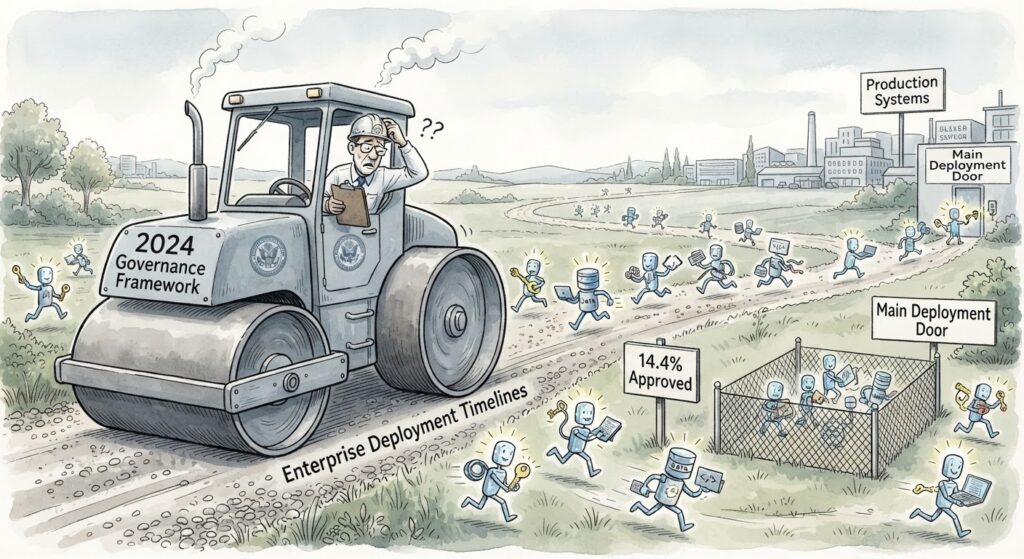
The gap opened faster than most governance teams absorbed
Most enterprises are deploying AI agents faster than their oversight frameworks can adapt. That compression matters not as a curiosity but as a signal about deployment velocity: operational exposure that once accumulated over years is now arriving in months. The structural consequence is a mismatch between what agents do and what governance was designed to handle.
As Jones Walker LLP observed in February 2026, “existing regulatory frameworks assume human decision-makers, not autonomous digital actors operating continuously across systems.” NIST’s subsequent AI Agent Standards Initiative — with listening sessions tracked by Jones Walker as of February 2026 — signals that this mismatch has become a formal Washington policy concern.
What changed: agents moved from assistants to actors
Earlier AI tools surfaced recommendations. Current agents execute multi-step workflows, call external APIs, write to databases, and trigger downstream processes — often without a human in the loop at each step. That is not a speed difference. It is a difference in who — or what — holds consequential action.
The Gravitee State of AI Agent Security 2026 Report found that only 14.4% of organisations report their AI agents go live with full security approval. The majority of deployed agents are therefore acting on real data and real systems before oversight is complete.
Gartner projects that through 2028, at least 80% of unauthorised AI agent transactions will stem from internal policy violations — information oversharing, unacceptable use, or misguided AI behaviour — rather than external attacks. The primary exposure is procedural, not adversarial. That distinction shapes where controls need to go.
Three compounding pressures behind the gap
A peer-reviewed framework paper published on arXiv in April 2026 identifies shorter development-to-deployment cycles, model drift, and multi-agent system interdependencies as compounding factors that make principled human oversight urgently necessary. Each is manageable in isolation. Together, they create cascading exposure: an agent that drifts from its original behaviour while operating inside a multi-agent pipeline, deployed faster than any review cycle can track, produces failures that are difficult to attribute and harder to reverse.
Enterprise accountability structures add a second layer of difficulty. California Management Review identified in October 2025 that enterprise leaders face a required shift from command-and-control to coordination-and-oversight as AI agents reshape organisations. Most compliance processes and accountability chains still assume a human actor at the point of decision. Agents do not fit that assumption.
Regulatory frameworks are moving, but unevenly. OSFI’s July 2026 Technology Risk Bulletin calls explicitly for institutions to “define ownership across the AI lifecycle and establish limits on autonomy” and to “implement AI harnessing alongside human oversight to maintain accountability and prevent unintended actions.” The EU AI Act’s tiered risk model is being applied to clinical AI governance, distinguishing assistive AI, predictive AI, and agentic AI executing multi-step workflows autonomously. None of these frameworks yet covers the full operational surface that enterprise agents now occupy.
Where the accountability gap is sharpest
Regulated industries — financial services, healthcare, critical infrastructure — face the most immediate exposure because regulators are already naming the failure mode. OSFI warns that “gaps in senior management understanding can lead to over-reliance on vendor-provided assessments, limiting effective scrutiny of AI behaviour.” A vendor’s assessment of its own system is not a substitute for internal accountability over what that system does inside your environment.
Unregulated sectors carry the same structural risk without the external deadline. Any organisation where agents touch customer data, financial transactions, or operational systems has the same accountability gap — just without a regulator currently requiring them to close it.
Gartner’s position is that applying uniform governance across AI agents will lead to enterprise AI agent failure. Uniform governance — the same controls applied to every agent regardless of what it does — remains the current default for most organisations.
What tiered governance requires in practice
Gartner’s autonomy-tiered model identifies four levels: Assist, Advise, Collaborate, and Act Autonomously. Level 4 — fully autonomous — requires continuous monitoring, circuit breakers, rapid rollback mechanisms, and clear ownership structures. Lower autonomy levels require proportionally lighter controls. The design principle is calibration to risk level, not uniformity across all agents.
Florence Healthcare’s governance team frames the same principle for clinical research: “your governance requirements should scale with that risk, not apply uniformly across every use case.” An agent that drafts a summary for human review sits at a different risk level than one that executes a financial transaction or modifies a patient record. The controls should reflect that difference.
The honest trade-off: tiered governance is harder to operate than uniform governance. It requires continuous agent classification, ownership assignment, and monitoring infrastructure. Classification is not a one-time exercise — agents change scope, models drift, and pipeline interdependencies evolve. Organisations that treat the initial tier assignment as permanent will find their governance framework decoupled from operational reality within months.
Three decisions before the next deployment cycle
Classify before you deploy. Map every active and planned agent to an autonomy tier. The tier determines which controls are required and which can be deferred without meaningful exposure. Treating all agents identically either over-burdens low-risk agents or under-controls high-risk ones.
Assign a named individual owner to each agent. OSFI’s bulletin and the arXiv framework paper both identify ownership gaps as a primary failure mode. The owner is responsible for the agent’s behaviour, scope, and audit trail — not a team, not a vendor, not a policy document. A person who can be held accountable when the agent acts unexpectedly.
Build and test rollback before deployment. Circuit breakers and rapid rollback mechanisms are required for Level 4 agents, per Gartner’s model. Organisations that deploy autonomous agents without tested rollback procedures typically discover the gap during an incident. Build and verify the mechanism before the agent goes live — not in response to a failure.
The competitive pressure counterpoint
Some organisations will argue that building governance infrastructure before deployment cedes competitive ground to faster-moving competitors. That concern is real — slower deployment has a cost, and a lower capture rate of deployment opportunities does reduce near-term return. The question is whether that cost is lower than the cost of the alternative.
As Jones Walker LLP observed, “organisations are deploying autonomous systems faster than governance frameworks can catch up, which is a pattern that reliably produces expensive lessons.” The governance investment does not eliminate deployment risk. But it changes when and how failures surface — and whether they are recoverable when they do.
Join the conversation or subscribe for weekly breakdowns on building dependable AI operations.
Eagentix helps growth-focused enterprises redesign and automate manual business processes. We combine executive strategy, implementation support, and managed services to build dependable operations across Southeast Asia.
Eagentix helps growth-focused enterprises redesign and automate manual business processes. We combine executive strategy, implementation support, and managed services to build dependable operations across Southeast Asia.
Sources
- – Gartner Says Applying Uniform Governance Across AI Agents Will Lead to Enterprise AI Agent Failure
- – Gartner® Market Guide for Guardian Agents Explained
- – Keeping an Eye on AI: A Framework for Effective Human Oversight of AI Systems
- – NIST’s AI Agent Standards Initiative: Why Autonomous AI Just Became Washington’s Problem | Jones Walker LLP
- – AI Governance Framework for Clinical Research | Florence
- – Generative and Agentic Artificial Intelligence: Implications for Technology, Cyber Security, and Operational Resilience – Office of the Superintendent of Financial Institutions
- – The Non-Human Enterprise: How AI Agents Reshape Organizations | California Management Review
- – EXCLUSIVE: AI researchers warn companies rushing self-improving systems despite safety risks | Reuters
- – healthcare ai’s rapid adoption necessitates robust …
- – Scaling Artificial Intelligence in Health | OECD
- – What Are Guardian Agents? Why Enterprises Need Them
- – State of AI Agent Security 2026 Report: When Adoption Outpaces Control
- – The State of AI in the Enterprise – 2026 AI report | Deloitte US
- – 1Password’s research finds AI agent adoption is outpacing governance | 1Password
- – Research acceleration: The view inside OpenAI | OpenAI
- – Challenges & Frameworks for AI Governance | WashU Law
- – When AI Agents Attack: Autonomous Cyber Operations and Europe’s Governance Gap | Carnegie Endowment for International Peace
- – A multi-agent debate workflow for construction projects
- – Technical Limitations of LLM-Based AI Agents and Their Links to Bias and Governance Challenges: A Narrative Review
- – Managing the AI workforce must mirror managing the human workforce | Ejento AI
- – The AI Agent Governance Gap: What CISOs Need Now – Lab Space
- – 12 Industries Being Transformed by AI Agents | MindStudio
- – Global Agentic AI Landscape Report 2026 | RAYSolute
- – Multi-Agent Debate Strategies: Survey, Taxonomy, and Challenges
- – Search Results | Tribe Insights
- – Towards a science of scaling agent systems: When and why agent systems work