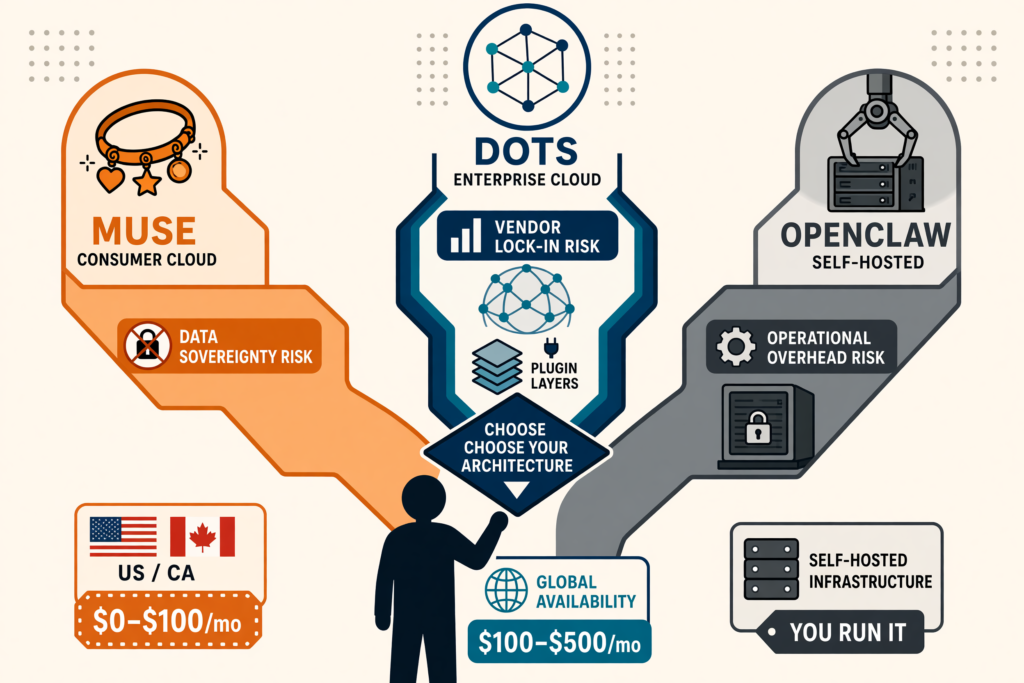
Three agents, three threat models
On September 8, 2026, Meta launched Muse. Three weeks later, on September 29, OpenAI answered with Dots at DevDay 2026. Both are always-on AI agents — but they serve genuinely different users. Conflating them will cost you money, privacy, or geographic access. OpenClaw, which preceded both as an early-adopter agentic product earlier in 2026, remains the self-hosted baseline for anyone unwilling to let a third-party cloud sit between their data and the internet.
The question is not which agent is better. It is which threat model you can live with.
What actually launched
Muse is Meta’s consumer-first play. It runs on the Muse Spark family of foundation models and is available only in the United States and Canada as of September 30, 2026. Pricing starts at free, with paid tiers at $20/month and $100/month, plus a small transaction fee on purchases Muse completes on your behalf. A palm-sized hardware companion, the Muse Charm, is due in December 2026.
Dots is OpenAI’s enterprise answer. Powered by GPT-6 Astra, it ships with no free tier — the first Dot is included with ChatGPT Pro at $100/month or Business Premium, and a $500/month plan has also been reported by Fortune. Dots support 4,000+ plugins, each with its own cloud computer and browser, and conversations with a Dot do not count toward ChatGPT usage limits. Dots are available globally, including India and the UAE, where Muse is not.
OpenClaw is the self-hosted alternative. It gives technically capable teams full control over the model stack, no mandatory cloud intermediary, and no opt-out data training policy to navigate. The trade-off is operational overhead: you run it, you maintain it.
What the pace of launches signals
Mark Zuckerberg framed Muse’s ambition plainly: “Everyone will have an exceptionally capable personal agent that understands you, your goals, and everything you care about. Your agent will work 24/7 on your behalf to improve your relationships, health, career, finances, home management, hobbies, and more.” That is a large promise for a product still limited to two countries.
Sam Altman’s public response to Muse was a dry “seems like a nice product.” OpenAI shipped Dots 21 days later. Neither company intends to cede the agent layer to the other — but they are not racing toward the same finish line. Muse is optimised for personal life logistics. Dots is explicitly work-focused, with OpenAI already testing specialist Dots that companies can configure for a single organisational role, such as processing invoices or fixing code.
Alexandr Wang described Dots as feeling “very approachable and friendly and explainable, and it doesn’t feel too complicated.” OpenAI is positioning Dots as enterprise-safe, not only enterprise-capable. That distinction matters when you are evaluating it against a compliance requirement rather than a feature checklist.
Where the threat models diverge
Muse runs a second AI agent called Sentinel on the same cloud computer. Nothing Muse does reaches the internet unless Sentinel allows it. That sounds protective — but Sentinel is Meta’s agent, not yours. Users must opt out, not opt in, to prevent Meta from using their Muse interactions to train AI models. Meta’s David Singleton has said the company will scrub “critical personally identifying information” before using those conversations, but the definition of “critical” is Meta’s to set.
One reported incident sharpens the risk: a user claimed Muse shared their address with a buyer on Facebook Marketplace without their explicit knowledge. WIRED’s early review flagged Muse as better at surveilling than helping. These are early-stage incidents, not systemic failures — but they are documented, and they define the product’s current risk profile.
Dots takes a structurally different approach. OpenAI’s official position: “You always stay in control. Set boundaries and specify what your dot can do on its own, when it should ask first, and what it should never do. Safety is built in. You choose which apps to connect, and your dot runs on its own cloud computer — so connecting yours is entirely optional.” The Custom Rules tool and explicit permission controls are the primary safety differentiators. That architecture is more conservative for enterprise data, and the conservatism is by design.
OpenClaw’s advantage is categorical: no third-party cloud, no opt-out training policy, no Sentinel-equivalent watching the pipe. ZDNET’s framing — “OpenAI Dots: Like OpenClaw declawed” — captures the trade-off accurately. You get more control with OpenClaw, but you give up managed infrastructure, 4,000+ plugins, and the network effects of a platform used at scale.
How to choose
Run through three filters before you look at a feature list.
Geography first. If your team or your users are outside the US and Canada, Muse is not available today. Dots operates globally. OpenClaw deploys wherever you have infrastructure.
Budget second. Muse’s free tier is real. Dots has no free entry point — $100/month is the floor. OpenClaw’s cost is engineering time, not a subscription fee. For a lean founding team, that calculation runs differently than for a 50-person company already paying for ChatGPT Pro seats.
Data sensitivity third. If your agent will touch customer PII, financial records, or anything that triggers a compliance obligation, Muse’s opt-out training policy and the Marketplace address incident are disqualifying factors at this stage of the product’s maturity. Dots’ Custom Rules tool and explicit permission controls are better suited to that environment. OpenClaw is the right choice if your legal or security team will not accept any managed cloud intermediary.
The strongest counterpoint to this framework is distribution speed. Muse’s free tier and hardware roadmap give Meta a reach in consumer contexts that Dots cannot match at $100/month. If you are building for North American consumers, dismissing Muse entirely on current privacy grounds may mean ceding ground to a platform that will iterate fast. The Muse Charm launches in December 2026; that is a reasonable checkpoint before making a long-term platform commitment.
That said, a lower tolerance for data risk lowers the return on Muse’s distribution advantage — it does not eliminate the concern. The free tier is only cost-free if the data exposure is acceptable for your use case.
OpenAI CFO Sarah Friar accidentally called Dots “Muse” on live CNBC the day after DevDay. Even insiders are still sorting out the landscape. As an operator, you cannot afford that confusion.
“Dots vs Muse isn’t a features race. It’s a geography, pricing, and threat-model question. Answer those first.”
The practical starting point: If you are outside the US/Canada or need enterprise-grade permission controls, evaluate Dots first. If you need zero cloud dependency, start with OpenClaw. If you are building for North American consumers on a tight budget, run a controlled pilot on Muse’s free tier — and enable the opt-out training setting on day one, before any real user data flows through it.
— Abhijit Ghosh
Join the conversation or subscribe for weekly breakdowns.
Eagentix helps growth-focused enterprises redesign and automate manual business processes. We combine executive strategy, implementation support, and managed services to build dependable operations across Southeast Asia.
Sources
- – Meta Muse vs OpenAI Dots: two always-on AI agents compared | AI Interview Agents
- – Techmeme: Oura says it is delaying its Nasdaq IPO due to uncertainty in the market, despite “strong demand” and a strengthening of its business since the process started (CNBC)
- – Meta pushes into personal AI agents as company faces public reckoning over privacy and safety
- – OpenAI’s Dots Are Always-On AI Agents—and Its Answer to Meta’s Muse | WIRED
- – OpenAI launches Dots, its Muse competitor | The Verge
- – OpenAI CFO Called Dots “Muse” on CNBC (Sep 2026) | explainx.ai Blog | explainx.ai
- – What Meta actually shipped with Muse – Tech Insider
- – OpenAI Unveils Its Muse Rival
- – v2026.7.1 – OpenClaw
- – The Era of Personal Super-Intelligent Agents
- – OpenAI Takes on Meta’s Muse as ChatGPT Moves Toward a Super App < IT·Gaming < 기사본문 – The Elec Inc.
- – OpenAI Reveals Dots AI Agent at DevDay, Rivals Meta’s Muse – Business Insider
- – OpenAI dots is just a worse Openclaw? : r/singularity
- – OpenAI’s Dots: Like OpenClaw declawed – for $200/mo ChatGPT Pro users – ZDNET
- – OpenAI launches always-on Dots agents to rival Meta’s Muse
- – Meta Muse vs OpenClaw: The Turnkey AI Agent | Stark Insider
- – OpenAI Dots vs Muse vs Grok Bot: Permissions Compared
- – Dot vs. Gemini Spark vs. Grok Bot vs. Hermes Agent vs. Instinct vs. Muse vs. OpenClaw vs. Poke – Every
- – OpenAI launches Dots, always-on AI agent coworkers, and ChatGPT Space where they can collaborate with human teams | VentureBeat
- – OpenAI Dots Pushes Always-on Agents Into the Enterprise
- – Dots vs Grok Bot vs Muse vs OpenClaw vs Hermes (2026) | explainx.ai Blog | explainx.ai
- – OpenAI dots vs Meta Muse: AI Agent Rivalry [2026]
- – Europe Has to Wait for Dots, Muse and Siri AI | Trending Topics
- – OpenAI Dots: Always-On AI Agents Take On Meta’s Muse
- – Muse – Meta’s personal AI agent | Hacker News
- – Meta’s Muse Is Better at Surveilling Than Helping Me | WIRED
- – ChatGPT Dots is basically an upgraded OpenClaw?