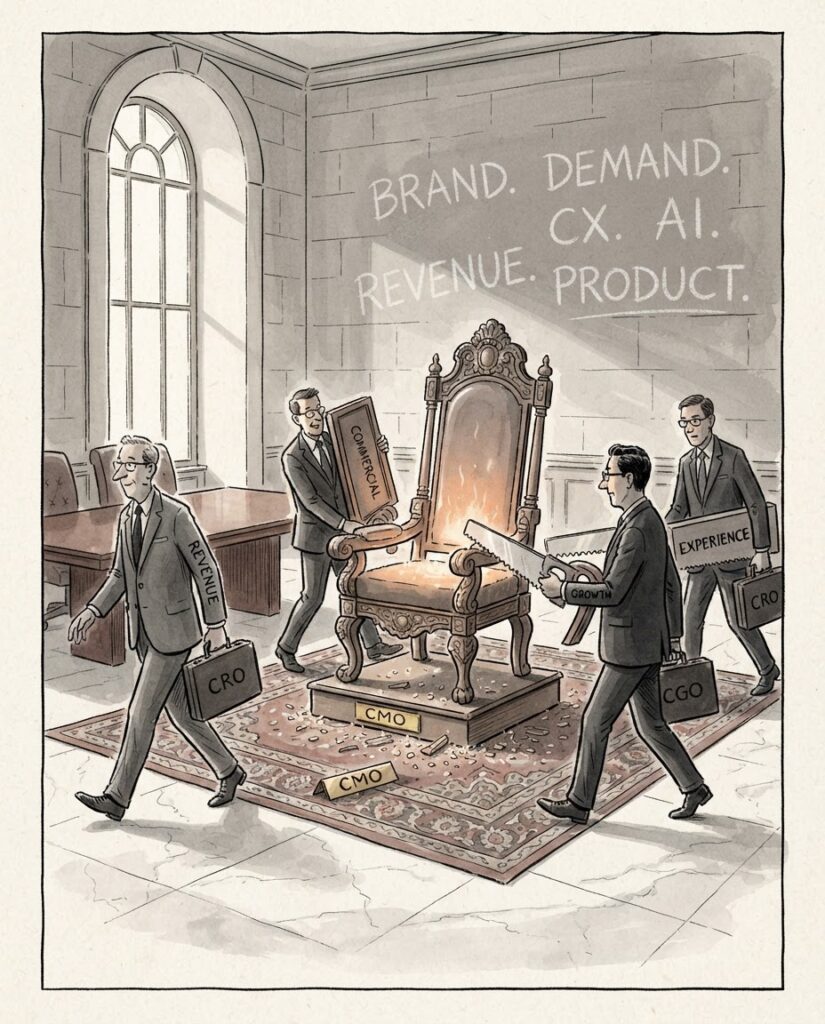
The title is shrinking. The work is expanding.
UPS eliminated its CMO role. Etsy handed marketing to its COO. Walgreens distributed the function across several senior leaders. None of them stopped doing marketing. They just stopped calling the person in charge a Chief Marketing Officer.
That distinction matters more than most coverage acknowledges. According to Forrester’s 2025 study, as cited by Behind the CMO, only 49% of Fortune 500 top marketers hold the CMO title today — down from 55% just one year earlier. A separate figure from Basis puts the share of Fortune 500 companies using the CMO title at 36%, down from 49% a year prior. These two datasets measure different things — top marketer titles versus company-level title usage — so they should not be read as the same measurement. But the direction is identical. The title is in retreat across every way you slice it.
The thesis most commentary misses: the title is disappearing precisely because the job got too big. Not because marketing stopped mattering. Because it started mattering for everything.
Why the job outgrew the title
Consider what a modern marketing leader is now expected to own: brand identity, demand generation, customer experience, product marketing, AI strategy, revenue accountability. That is not a marketing brief. That is a general management brief with a marketing lens.
So companies reached for titles that signal general management: Chief Revenue Officer, Chief Commercial Officer, Chief Growth Officer. Behind the CMO documents the pattern: at UPS, Kevin Warren’s departure produced a “Chief Commercial and Strategy Officer” who inherited marketing alongside global revenue, product management and growth strategy. These successor roles do not replace the CMO so much as absorb the CMO’s expanded remit under a label that a finance-trained CEO finds easier to trust.
That dynamic creates a structural problem. When the decision-maker cannot see the value of a function clearly, the title loses the argument — even when the function is winning. Marketing’s strategic contribution becomes invisible at the exact moment it is most consequential.
The counterpoint worth taking seriously
There is a credible version of the opposing argument. Some CMOs genuinely did stay stuck in campaign mode. They optimised impressions while the CFO optimised margin. They owned brand sentiment while the CRO owned pipeline. That gap was real, and some title eliminations were a fair response to it — not a misreading of marketing’s value, but an accurate reading of a particular CMO’s scope.
One contributor writing in Fast Company puts it plainly: CMOs who cling to old playbooks will not survive the transition. Those who are thriving have repositioned as transformation architects — connecting brand to revenue, data to product, and human judgment to AI execution.
But notice what that description sounds like. It sounds like a business leader who happens to understand marketing deeply — which is exactly the profile that gets hired as a Chief Commercial Officer. So the question is not really whether the CMO is dead. It is whether the person in the role expanded with the job, or waited to be replaced by someone who did. A lower rate of genuine expansion means more eliminations, not fewer. That outcome is worth conceding rather than arguing away.
What the unbundling looks like in practice
When marketing gets absorbed rather than led, specific things tend to break. Basis identifies three consistent failure modes: misalignment between CEOs and marketing leaders, fragmented customer ownership across functions, and the absence of shared success metrics. Remove a dedicated marketing executive and all three risks increase simultaneously — because no single owner remains accountable for the connections between them.
Basis also reports a related figure: senior marketing leaders sit on the executive team or report directly to the CEO at 52% of Fortune 500 companies, alongside a separate baseline figure of 58%. The source text’s own framing makes the precise direction of change between those two numbers internally inconsistent, so this should not be read as a confirmed directional trend. What is clear is the structural concern: when marketing loses its seat at the table, the function loses influence over decisions where its perspective is most needed.
The B2B context adds a further wrinkle. As Chris Koehler notes on LinkedIn, in B2B organisations where a CMO partners closely with a CRO and Chief Customer Officer, the role remains clearly valuable — owning brand, demand, product marketing and customer experience together. The risk, as Koehler’s thread makes clear, is that the role gets chipped away into something purely tactical before anyone notices the strategic cost.
Three implications for operators making this decision now
If you are eliminating the CMO title, be precise about what you are actually deciding. Consolidating marketing under a stronger general manager is a legitimate structural choice. Quietly downgrading marketing’s strategic seat is a different decision entirely — with different consequences for customer acquisition, brand equity and long-term pricing power. Conflating the two is where organisations create problems they diagnose too late.
If you are a CMO trying to hold the role, the defensive play will not work. The expansion has to be genuine. That means owning revenue outcomes, not just marketing metrics. It means leading AI adoption across the function — not just approving a martech stack, but setting the governance model for how AI touches customer-facing decisions. And it means building the CEO’s trust through commercial fluency, not brand sentiment scores.
If you are a CEO deciding whether to hire a CMO, ask a sharper question than “do we need marketing leadership?” Ask instead: who in my C-suite currently owns the connection between our brand, our customer data and our revenue model? If the honest answer is nobody — or everybody, which is the same thing — then the CMO role is not a cost. It is the gap your competitors are already exploiting.
The title may well keep shrinking. But the work it describes — making the market understand why your product is the right choice, at the right moment, for the right customer — is not optional. Someone has to own it, with authority, at the table where strategy gets made.
One action: Audit your current C-suite against the three failure modes Basis identifies — fragmented customer ownership, absent shared metrics, CEO-to-marketing misalignment. Score each as present, partial or absent. If two or more are fully present, you have a structural gap regardless of what title sits above the marketing function. That diagnostic takes an hour and surfaces a decision that typically takes a year to feel.
— Eagentix
Eagentix helps growth-focused enterprises redesign and automate manual business processes. We combine executive strategy, implementation support, and managed services to build dependable operations across Southeast Asia.
Eagentix helps growth-focused enterprises redesign and automate manual business processes. We combine executive strategy, implementation support, and managed services to build dependable operations across Southeast Asia.