The question most SOC modernisation debates get wrong
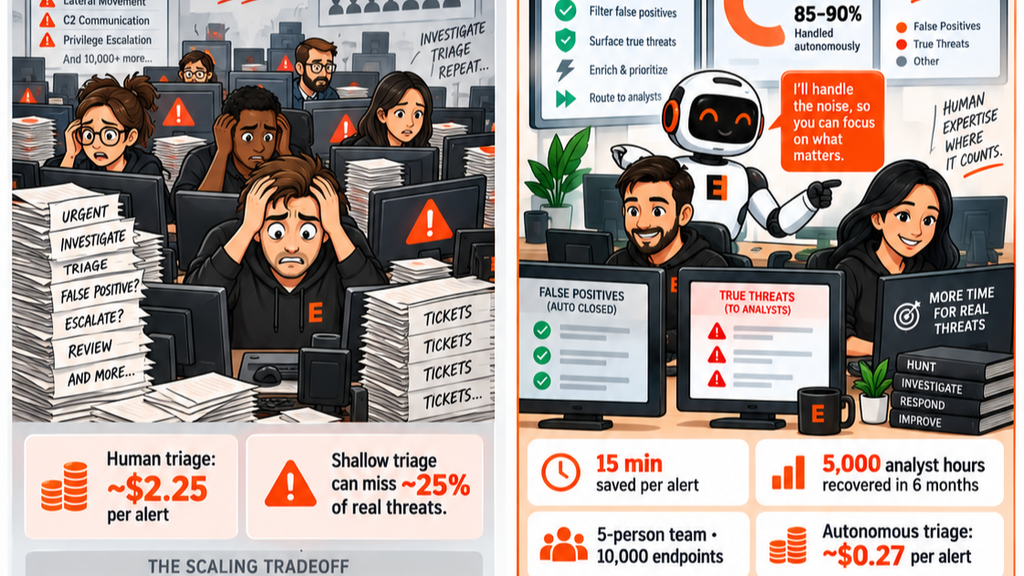
Security teams typically frame this choice as “is AI better?” That framing produces vendor-led answers. The useful question is: better at what, for whom, under which operational constraints? The two models solve different problems, and choosing between them without a shared set of criteria wastes budget and leaves real detection gaps open.
Five criteria that separate the models in practice
Detection method, alert volume handling, analyst workload, deployment flexibility, and total cost trajectory. Everything else — dashboards, integrations, brand names — is secondary until these five are settled. If a vendor pitch skips one of them, that is usually the dimension where the product is weakest.
Traditional SOC: where it still holds
A traditional SOC uses rule-based, signature-driven detection. Analysts write correlation rules, review alerts manually, and escalate through a defined tier structure. Every alert traces back to a named rule, which makes audit trails clean and regulatory arguments straightforward. When an auditor asks why a specific event triggered a response, a rule number is a cleaner answer than a model confidence score.
The structural costs are real, though. Signature-based detection cannot catch what it has never seen — zero-day exploits, living-off-the-land techniques, and insider threats that stay within normal-looking parameters pass through undetected. The scaling model is the less-discussed liability: traditional SOC costs grow linearly with analyst headcount. So every sustained increase in alert volume becomes a hiring conversation. The practical result is triage fatigue — analysts spending most of their shift on noise rather than genuine threats.
AI-powered SOC: what the sources actually say
An AI-powered SOC shifts the detection question from “is this bad?” to “is this abnormal for this specific environment?” — Darktrace’s published framing of the model darktrace.com. Behavioural analysis built on machine learning can surface zero-day exploits and insider threats that signature-based tools miss, because the model does not require a predefined attack signature to fire an alert. Darktrace also describes the model as a force multiplier: AI handles high-volume data analysis so analysts can focus on strategic remediation rather than repetitive triage.
Orchestration layers coordinate responses across multiple security tools automatically. Generative AI and LLMs translate technical findings into plain-language reports for leadership and auditors, reducing time spent on manual write-ups, according to the same Darktrace source.
On adoption direction: security leaders are increasingly treating AI-powered automation as a strategic priority, with budget expectations shifting accordingly — according to Gruve’s April 2026 comparison gruve.ai. Treat that directional signal as context, not a performance guarantee.
The strongest credible objection is explainability. When a model flags an anomaly, the analyst needs to understand why in order to make a sound escalation decision. Vendors are addressing this through context-aware analysis and human-readable alert summaries, but the gap between “the model said so” and “here is the traceable decision logic” remains real on some platforms. Verify explainability depth before committing — ask for a live demonstration on a real anomaly from your own environment, not a staged demo dataset.
Head-to-head on the five criteria
Detection method. Traditional SOC catches known threats reliably. AI SOC can catch known and behaviourally anomalous threats, including novel attack patterns — but requires a learning period to establish a baseline for your specific environment. During that period, detection quality is lower than the vendor’s steady-state claims.
Alert volume handling. Traditional SOC scales linearly with analyst headcount. AI SOC handles high-volume data analysis automatically, improving the analyst-to-alert ratio without proportional hiring — but only after the model is adequately tuned. A poorly tuned model can generate its own noise problem.
Analyst workload. Traditional SOC concentrates effort on Tier 1 triage. AI SOC shifts analyst effort toward investigation and response, which is a more sustainable use of expensive security talent — provided the organisation has analysts with the skills to act on higher-complexity escalations rather than just fewer of them.
Deployment flexibility. Traditional SOC tooling is mature across on-premises, cloud, and hybrid environments. Some AI SOC platforms also support these deployment modes: Seceon’s SeraAI, for example, supports on-premises, private-cloud, and air-gapped deployments seceon.com. Verify your specific compliance requirements against each vendor’s deployment documentation — do not assume either model is automatically compliant.
Cost trajectory. Traditional SOC costs scale with headcount and rule-maintenance effort. AI SOC carries higher upfront platform cost but, in principle, reduces the marginal cost of scaling coverage. The crossover point depends on your alert volume and current analyst cost. Calculate it for your environment using your own numbers, not a vendor’s generic ROI model — and note that a lower-than-expected alert capture rate lowers the return.
Which model fits which situation
A traditional SOC remains a defensible choice when your threat surface is well-defined, your compliance framework demands fully traceable rule-based detections, your team lacks the operational maturity to tune an ML model, or your budget does not support a platform transition now. In those conditions, investing in better rule hygiene and analyst training is a more honest use of resources than buying AI capability you cannot yet operationalise.
An AI-powered SOC earns its cost when alert volume has outgrown analyst capacity, when you face insider-threat or zero-day risk that signature tools structurally cannot address, or when analyst retention is suffering because Tier 1 triage is consuming all available bandwidth. It also fits organisations with the governance maturity to audit model decisions and the vendor relationship to demand explainability.
Neither model is a universal winner. A hybrid path — AI-augmented triage sitting on top of an existing SIEM, with human analysts retaining escalation authority — is one approach Conifers AI’s 2026 operational guide describes as a way to coordinate responses across tools while preserving human decision-making conifers.ai. That path lets you validate AI detection quality against your known-good rule output before reducing reliance on the traditional layer.
One concrete next step
Before your next vendor conversation, pull your last 90 days of alert volume and map it against analyst hours spent on Tier 1 triage. If triage is consuming more than half of available analyst time, the traditional model is already failing you on workload — and that single data point changes the economics of every AI SOC proposal you will receive. Run that calculation first, using your own numbers. Everything else follows from it.
— Eagentix
Eagentix helps growth-focused enterprises redesign and automate manual business processes. We combine executive strategy, implementation support, and managed services to build dependable operations across Southeast Asia.
Eagentix helps growth-focused enterprises redesign and automate manual business processes. We combine executive strategy, implementation support, and managed services to build dependable operations across Southeast Asia.
Sources
- Digital Electronic System-on-Chip Design: Methodologies, Tools, Evolution, and Trends
- Requested for Technical specification available for DRIVE AGX ORIN SERIES SOC – DRIVE AGX Orin General – NVIDIA Developer Forums
- Traditional vs AI-Led SOC | Key Benefits and Implementation Strategies
- AMD vs. AVGO vs. META vs. MSFT vs. NVDA: Semiconductor & AI Stocks Fall Despite Creating an Open Specification for AI Infrastructure | Markets Insider
- AI SOC vs Traditional SOC: Faster Threat Detection & Lower Costs Explained
- Product specification for Beacon Fell Traditional …
- AI-Powered SOC: The Definitive Guide for 2026
- AI SOC vs Traditional SOC: What’s the Difference? – Seceon Inc