The demo works. Production doesn’t.
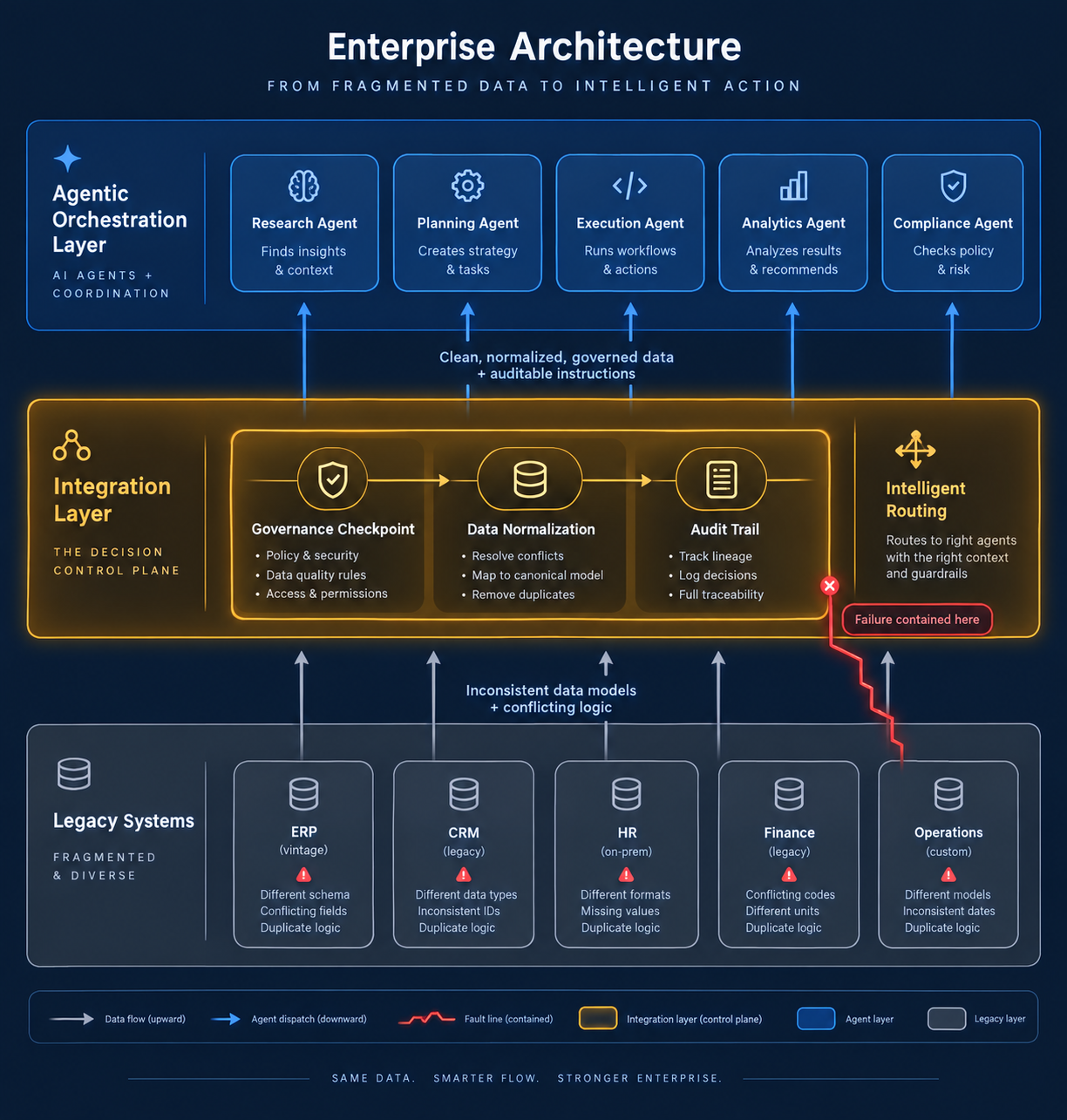
The agent performs cleanly in a controlled environment — it retrieves context, executes a workflow, hands off to the next step. Then it hits your actual enterprise stack. It queries inconsistent data models, duplicates logic distributed across three separate systems, and produces decisions nobody can audit. The model hasn’t changed. The architecture has.
The Bluepes editorial team states it plainly: “Enterprise AI automation projects rarely stall at the model level — they stall at the data and integration layer.” The integration layer is the consistent failure point — and most architecture conversations are still happening one level above it.
The thesis here is specific: the integration layer is no longer a plumbing concern. It is the point where agentic AI either compounds in value or fragments into a collection of capable-looking assistants that never add up to a transformed organisation. Enterprises that architect for agentic composability now are making a different kind of bet than those investing primarily in model capability.
What “Agentic Composability” Actually Means
Composability in the conventional sense means building systems from interchangeable, independently deployable components. Agentic composability extends that principle to AI agents themselves — treating them as first-class orchestration citizens that coordinate workflows, transact on behalf of the business, and enforce governance across domains. The goal is not a smarter chatbot. It is an execution layer.
Sana Remekie, who contributed to the MACH Alliance Interoperability Task Force and the MACH Reference Architecture in 2025, frames the dependency directly: “Composability is the key enabler of Agentic AI. Without it, enterprises simply can’t move fast enough or connect the dots across systems to make intelligent agents truly useful.” That framing from MACH X describes an architectural prerequisite, not an aspiration.
Rierino’s June 2026 guide for enterprise architects draws the boundary precisely:
“Composable without agentic: The enterprise has well-organized capabilities, but people still coordinate decisions across them. Teams can change systems faster, yet they remain the connective tissue between product data, content, workflows, and commercial operations. Agentic without composable: Agents are asked to act across tangled systems, duplicated logic, and inconsistent data models. They may appear capable in a demonstration, but their decisions become less predictable once they encounter the full complexity of production.”
Neither half works alone. Each path has a distinct failure mode, and the failure modes are different in character: composability without agents leaves humans as the connective tissue; agents without composability produces unpredictable decisions at production scale.
The Architecture That Serious Organisations Are Building
In October 2025, Salesforce published its Agentic Enterprise IT Architecture framework — an 11-layer stack that evolves siloed platforms into composable application services governed by a new Enterprise Orchestration Layer. One component stands out: a cross-domain Semantic Layer built around an Enterprise Knowledge Graph, which Salesforce identifies as a prerequisite for agent coordination across business domains with differing policies and semantic definitions. Agents operating across finance, supply chain, and customer experience without a shared semantic layer are, in effect, working from different vocabularies.
Algolia’s February 2026 analysis makes the governance stakes concrete: “This is where governance gets enforced. Escalation rules, approval workflows, and cross-agent coordination all happen at the orchestration layer. Without it, you’re relying on individual agents to self-coordinate, which doesn’t scale and makes auditing nearly impossible.” Self-coordinating agents at scale is not a design pattern. It is a liability — and Algolia also notes that without explicit architecture, agentic systems risk making unauditable changes to production systems.
QuantumBlack (McKinsey) published its own guidance in April 2026. Their ARK case study demonstrated that integrating workflow automation platforms including n8n and Zapier with an agentic runtime — while maintaining composability — removed coordination overhead between operations and AI teams without requiring changes to existing operating models. Agent reuse across workflows became achievable because the underlying architecture was modular and interface boundaries were clean. QuantumBlack also recommends CIOs ensure short-term agentic builds are ‘compostable’ — designed to be removed and replaced as the market matures — explicitly acknowledging that most agentic platform components today are purchased, not built in-house.
The Counterpoint Worth Taking Seriously
The strongest objection to prioritising composability now is timing. Agentic infrastructure is genuinely immature. Standards are unsettled. Most platform components are still being purchased rather than engineered. A reasonable CIO might ask: why invest in architecting a layer that vendors haven’t finished building?
That concern is legitimate. But deferring architecture is not a neutral decision. Rierino identifies the consequence directly: “Without that execution layer, enterprises accumulate isolated assistants that improve individual tasks without changing how the organisation operates.” The cost of deferral is not a clean slate later — it is a growing inventory of disconnected agents, each requiring its own integration work to replace or extend. Architectural debt in agentic systems is particularly costly because agents act: they write to production systems, trigger financial transactions, and modify records. Unauditable changes, as Algolia notes, are not a theoretical risk in this context.
The question is therefore not whether to architect now versus later. It is how to architect for adaptability under uncertainty — which is precisely what composability is designed to provide. A lower level of architectural investment now does reduce near-term risk and cost; it also reduces the organisation’s ability to compound agent capability over time. That trade-off is real and worth naming explicitly.
Three Decisions Worth Making This Quarter
Audit your integration layer before expanding your agent footprint. Bluepes points to Boomi-based environments as examples where agentic extension is achievable without rebuilding from scratch. The operative question is whether your existing data contracts are clean, governed, and accessible in real time. If they are not, agents will inherit every inconsistency — and surface it at production scale.
Treat the orchestration layer as a governance asset, not a technical detail. Escalation rules, approval thresholds, and cross-agent coordination policies belong in the architecture, not in individual agent prompts. Agents that self-govern in production are, in practice, ungoverned.
Build for replaceability from the start. QuantumBlack’s ‘compostable’ framing is operationally useful here. Any agentic component deployed today should have a defined interface boundary — so that when a better model, orchestrator, or data connector becomes available, it can be swapped without dismantling the surrounding system. Lock-in at the integration layer is more dangerous than lock-in at the model layer because it is harder to detect and slower to unwind.
The organisations best positioned for the agentic era are not necessarily those with the most capable models. They are the ones whose integration layer is ready to route, govern, and compose intelligent work across domains. That is the architectural decision that compounds — or doesn’t.
— Abhijit Ghosh
If this framing is useful, join the conversation below or subscribe for weekly breakdowns on enterprise architecture and agentic AI.
Eagentix helps growth-focused enterprises redesign and automate manual business processes. We combine executive strategy, implementation support, and managed services to build dependable operations across Southeast Asia.
Sources
- – How Composability Enables Agentic AI at MACH X – LinkedIn
- – The Agentic Enterprise – The IT Architecture for the AI …
- – Agentic AI enterprise integration: what it needs to work – Bluepes
- – Creating a future-proof enterprise agentic platform architecture
- – What Is an Agentic Platform? A 2026 Guide for Enterprise Architects
- – Agentic Architecture: Designing AI Agents for Enterprise Systems
- – How to build an Agentic Enterprise with AI: A 4-layer architecture | Emin Eliot Gerba posted on the topic | LinkedIn
- – The AI-Native Enterprise: Rearchitecting Your GTM Stack for Agent-Driven Operations – Enterprise Architecture Professional Journal
- – Understanding Agentic AI Infrastructure
- – Rethinking enterprise architecture for the agentic era | McKinsey
- – Agentic Thinking in Composable Enterprise Architecture
- – Agentic architecture: blueprint for enterprise AI
- – Enterprise AI Needs a New Agentic Architecture. – LinkedIn
- – What is Agentic AI? How OpenText Powers Enterprise Success
- – The Evolution of Agentic AI Software Architecture
- – Agentic AI – Ongoing coverage of its impact on the enterprise
- – Agentic AI Development for Enterprise | TechAhead