The investment breakdown is a supply-chain signal, not a portfolio move
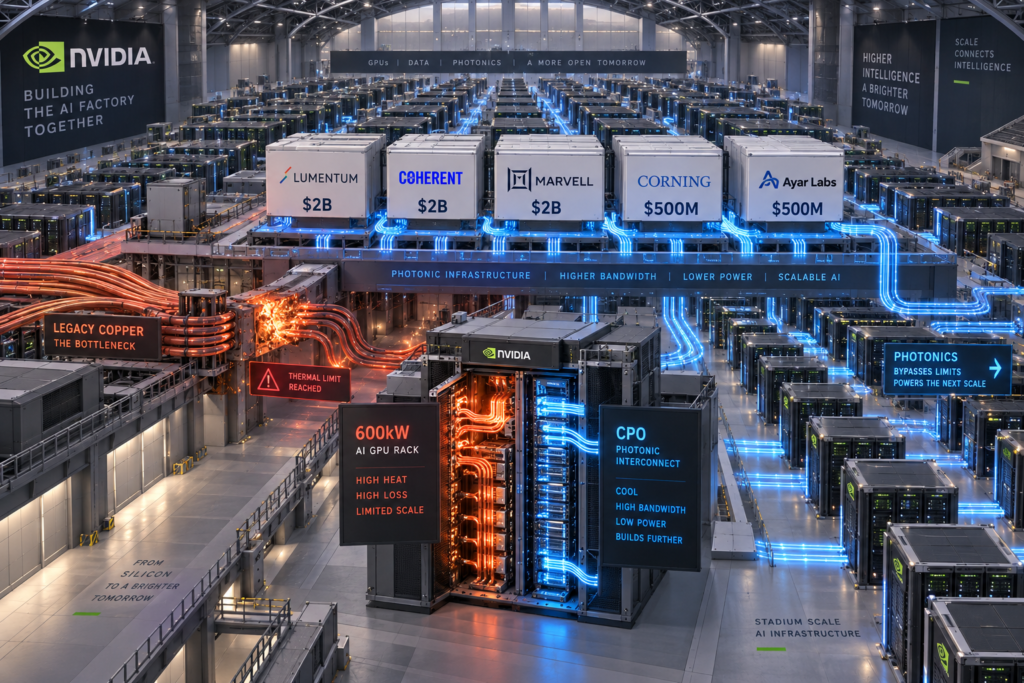
In the three months before May 29, 2026, NVIDIA committed at least $6.5 billion into photonics companies. CNBC reported the breakdown: $2 billion each into Lumentum, Coherent, and Marvell, $500 million into Corning, and participation in Ayar Labs’ $500 million Series E. The specificity of those allocations — named suppliers, named amounts, compressed timeframe — points to a company securing manufacturing priority, not diversifying a balance sheet.
Jensen Huang was direct at NVIDIA GTC in March 2026. Silicon photonics capacity, he said, “is substantially higher than the world has today.” That statement describes a supply gap, not a technology gap. The distinction matters for how executives outside the photonics industry should respond.
Why copper is hitting a physical ceiling now
The shift is not speculative. NVLink-connected GPU domains expanded from 72 GPUs in Blackwell to larger configurations in Rubin, pushing electrical signaling toward its physical bandwidth-per-watt ceiling at 800 Gbps, according to Futurum Group’s analysis. A single AI rack can now draw up to 600 kW. At that power density, copper interconnects become an energy constraint before they become a bandwidth constraint.
Huang described the architectural logic in Optics & Photonics News in November 2025: “We use copper as much as we can on scale-up, but on scale-out, where the data centers are now the size of a stadium, that’s where silicon photonics comes in.” Hyperscalers are building at stadium scale now. That makes photonics a current procurement decision, not a future architecture review.
NVIDIA’s CPO-based systems — Quantum-X and Spectrum-X Photonics — target power consumption reductions of up to 3.5x and resiliency improvements of up to 10x compared with electrical alternatives, per Futurum Group. These are targets, not guaranteed outcomes, and actual results will depend on deployment configuration. Even so, performance improvements at that order of magnitude tend to reset vendor selection criteria across the supply chain, not just at the hyperscaler tier.
Who carries indirect exposure
The equity markets have already repriced the named suppliers. Lumentum stock rose 134% since the start of 2026; Coherent gained 96%; Marvell climbed 122%; Corning added 111% — all as of May 29, 2026, per CNBC Africa. Equity repricing reflects expected future scarcity. It does not resolve the underlying manufacturing constraint.
The executives with the most immediate exposure are not building photonics products. They are buying AI capacity from cloud providers, co-location operators, and GPU cluster vendors who are now competing for the same constrained optical components. If your infrastructure roadmap depends on hyperscale interconnects or AI-dense co-location, you are inside the photonics supply chain whether or not your procurement team has mapped it.
Alan Weckel put the structural problem plainly on CNBC on May 29, 2026: “The industry has never seen this type of demand or growth, so ramping the supply chain to match demand, especially when constrained, is challenging.” Supply-chain ramps in photonics are measured in years, not quarters.
The packaging constraint that makes this harder than the GPU shortage
Photonics packaging can consume more than 80% of total manufacturing cost and remains largely a device-by-device process that resists full automation, according to Optics & Photonics News. This is the constraint that makes photonics supply structurally different from semiconductor supply. You cannot simply add fab capacity and wait for yield to improve. Each device requires precision alignment of optical and electrical elements — a process that has not yet been reduced to the kind of high-throughput automation that semiconductor fabs rely on.
That is why NVIDIA is investing directly into suppliers rather than purchasing on the open market. Brian Colello explained the logic on CNBC Africa: “By investing in photonics companies, NVIDIA is making sure that advancements in photonics continue and it will prevent them from hitting a scalability and performance wall that will occur if they remain on electrical and copper.” NVIDIA is purchasing allocation priority. Buyers without equivalent leverage will receive what remains after those allocations are filled.
Intel has shipped 8 million photonic chips with 32 million integrated lasers, with OCI implementation supporting up to 4 terabits per second bidirectional data transfer, per Stanton Chase’s November 2025 analysis. Silicon photonics transceivers are scaling from 800G toward multi-terabit speeds. Scaling performance and scaling supply volume are separate problems. The first is an engineering problem with a clear roadmap. The second is a manufacturing process and talent problem, and both take years to close.
The counterpoint worth taking seriously
Most enterprises do not procure photonic components directly. The reasonable objection is that this is a hyperscaler and infrastructure vendor problem, not an enterprise problem. That objection was equally reasonable about GPU supply in 2021 — until allocation constraints at the hyperscaler tier flowed downstream and mid-market AI builds encountered multi-quarter wait times. Indirect exposure does not disappear because it is indirect. It surfaces later, under more pressure, with fewer options.
The photonics situation adds a complication the GPU shortage did not have: the manufacturing bottleneck is process-level, not capacity-level. Adding wafer starts at a semiconductor fab is a capital decision. Improving photonics packaging yield at scale requires process innovation that capital alone cannot accelerate on a short timeline. If the constraint bites, it will not resolve in one or two quarters the way some GPU shortages did.
Three actions worth running now
First, audit your AI infrastructure dependencies two tiers deep. Identify the optical component suppliers behind your primary cloud, co-location, and GPU cluster vendors — not just the vendors themselves. Most procurement teams have visibility to tier one. Tier two is where the photonics constraint actually lives.
Second, ask your co-location and cloud providers directly which photonics vendors they rely on and what their current allocation status is. Providers who have secured allocations will say so. Providers who have not may not volunteer the information unprompted.
Third, if you are evaluating AI cluster procurement for 2026 or 2027, add photonics interconnect roadmap as a first-order evaluation criterion alongside GPU availability and power density. A vendor with a strong GPU allocation but an unresolved photonics dependency is carrying a constraint that will surface during deployment, not during procurement.
The GPU shortage era demonstrated that the cost of early mapping is low and the cost of late discovery is high. The photonics constraint is earlier in its development than the GPU shortage was when most enterprises began paying attention. That gap is the window.
— Abhijit Ghosh
Eagentix helps growth-focused enterprises redesign and automate manual business processes. We combine executive strategy, implementation support, and managed services to build dependable operations across Southeast Asia.
Sources
- – Nvidia CEO Jensen Huang on Photonics Supply Bottleneck – LinkedIn
- – Coherent CEO Discusses AI Infrastructure and Photonics on CNBC
- – Executive Search in the Photonics Era
- – REPLAY: CTO PANEL AT THE Optica Executive Forum … – LinkedIn
- – NVIDIA’s $4B Optics Bet Signals Photonics as AI’s Next Bottleneck
- – Nvidia is investing billions into this emerging technology that could change the AI industry | CNBC Africa
- – This major AI bottleneck could be solved using light
- – Optics & Photonics News – AI Factories: Photonics at Scale
- – The Next AI Bottleneck Isn’t Chips: What to own…
- – Nvidia Targets AI Infrastructure Bottleneck With $2 Billion …
- – NVIDIA leads industry shift to photonic interconnects with …
- – NVIDIA Just Named AI’s Next Bottleneck—And These 3 Stocks Sit …
- – Photonics: The AI Bottleneck Beyond Memory
- – Weekend Deep Study: AI Has A New Bottleneck ~ LIGHT. Who Win…
- – Nvidia is investing billions into tech that could change the AI sector
- – Nvidia Bets $6.5B on Photonics to Solve AI’s Next Big Bottleneck
- – A Beginner Guide to Photonics – TacticzHazel’s Substack
- – NVIDIA is investing $2 billion in this photonics company. The reason …
- – The 100-Second Bottleneck Behind NVIDIA CPO: 7 Companies That Own the 4-Stage Test Stack
- – AI Value Chain Bottlenecks: Mapping Pricing Power and …