The problem wasn’t the model
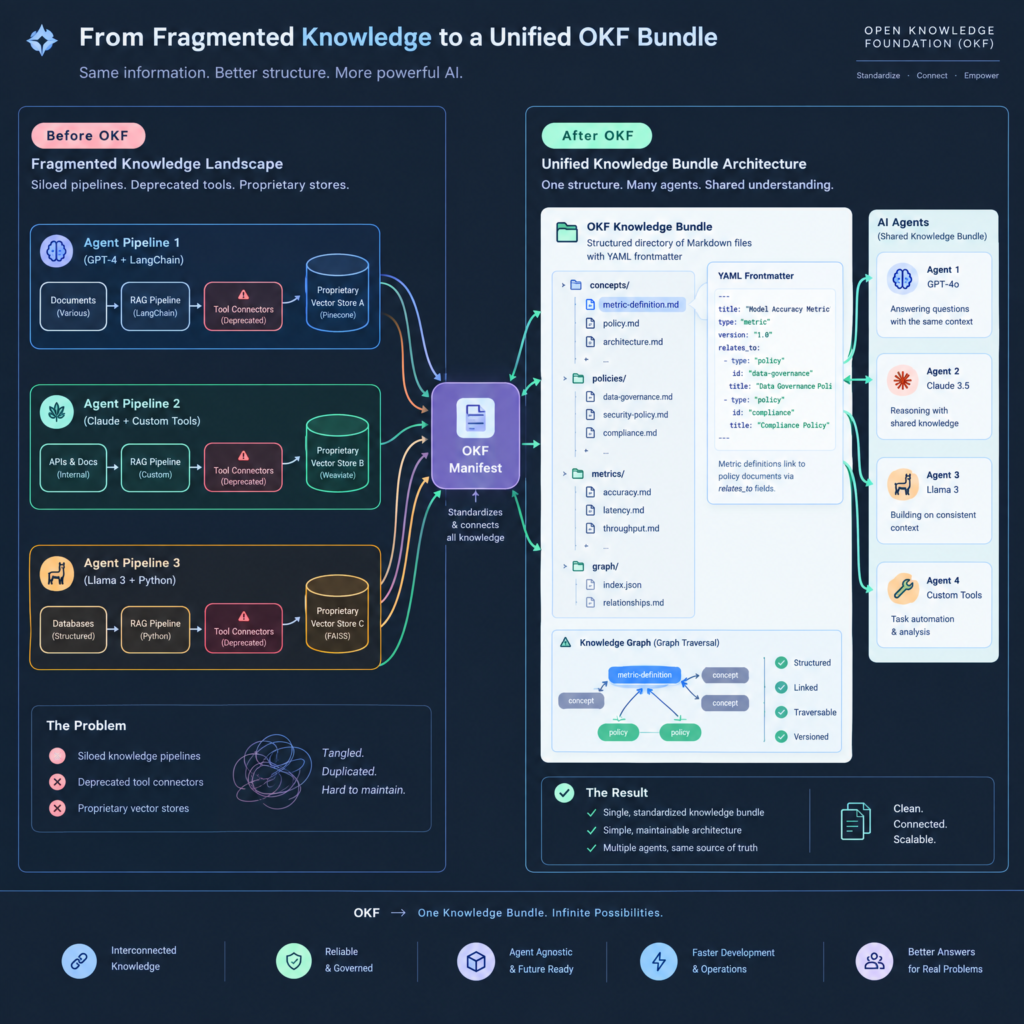
Every team building seriously with AI eventually hits the same wall. One agent reads from a proprietary vector store. Another pulls from a hand-crafted RAG pipeline tuned for a specific model. A third consumes documents formatted for a tool that got deprecated last quarter. When you want to share that knowledge across teams, tools, or models, you are almost always starting from scratch.
The models kept improving. The fragmentation didn’t.
Google Cloud has introduced the Open Knowledge Format (OKF), an open specification designed to standardize how organizational knowledge is packaged and shared with AI agents. Google Cloud’s announcement describes the spec as formalizing the “LLM-wiki” pattern — the idea of maintaining a plain-text knowledge base you hand directly to a language model — into a portable, interoperable format.
The thesis here is not that OKF will win. It’s that the problem it names is real enough that some standard will win — and operators who wait for consensus may find themselves retrofitting their entire knowledge layer.
What OKF v0.1 actually is
Strip the announcement language and the spec is genuinely minimal. Google describes OKF v0.1 as a directory of Markdown files with YAML frontmatter, governed by a small set of agreed-upon conventions. There is no compression scheme, no new runtime, and no required SDK. A bundle is just a folder.
Inside that folder, each file represents one concept — a metric definition, a policy, a product feature. A manifest file lists everything in the bundle. Each file’s frontmatter declares how it connects to other concepts, creating a knowledge graph that AI systems can traverse deliberately rather than guess at. GitBook’s analysis frames the shift precisely: OKF moves documentation from a human-only output to a first-class input for AI agents.
The spec is published on GitHub under the Apache 2.0 license. Reference implementations and tooling currently center on Google Cloud, but the spec itself is vendor-neutral. MindStudio notes that any AI system — regardless of which LLM it uses — can ingest an OKF-compliant bundle as long as it implements the spec. The stated goal is cross-platform compatibility, not Google lock-in.
It is equally important to be precise about what OKF is not. It is not a search index — it does not retrieve or rank fragments. It is not a hosting service. Google Cloud’s framing is direct: what’s missing is a format, not another service.
Where OKF sits in the stack — and where it doesn’t
Confusing OKF with adjacent standards is easy. An XML sitemap lists pages on your site. An llms.txt file points crawlers toward your most useful content. OKF goes further: it hands the knowledge itself to an agent, packaged as files the agent reads directly.
Semrush’s breakdown captures the directional difference clearly. Sitemaps and llms.txt face outward, toward crawlers visiting your site. OKF faces inward, toward your organization’s own agents. That distinction matters for how you prioritize adoption.
Domo’s glossary entry places OKF precisely in the stack: it sits between your raw documentation and your AI retrieval systems, acting as a structured context source for RAG pipelines and agents. The format carries provenance metadata, so agents can cite sources and surface when content was last updated. That provenance layer matters in practice — it is what lets an agent tell a user a policy was recently updated rather than surfacing a stale answer with false confidence.
Domo also makes the right caveat: not every situation calls for OKF. If your knowledge already lives in a semantic layer or data catalog that your AI tools consume well, adding another format creates overhead without clear benefit. OKF is built for curated, narrative knowledge — metric definitions, policies, product features — not high-frequency transactional data that updates by the second.
The strongest counterpoint
The obvious objection: Google has launched open standards before that never achieved broad adoption. OKF v0.1 is, by Google’s own description, a starting point, not a finished standard. Reference tooling currently centers on Vertex AI. Teams already invested in competing knowledge infrastructure have little incentive to migrate.
That objection is fair. The value of OKF is not contingent on Google winning a format war, but adoption risk is real — a standard that stalls leaves early adopters maintaining a bespoke layer rather than benefiting from ecosystem tooling. The honest position is that OKF’s minimal surface area (plain Markdown and YAML) keeps the switching cost low in either direction. Teams that build toward structured, traversable, provenance-aware knowledge now will migrate more easily if a competing standard eventually dominates. Teams that ignore the underlying problem will not.
What this means for operators building now
Audit your knowledge layer for traversability. If your documentation is already Markdown-native, version-controlled, and cross-linked, GitBook notes you are closer to OKF readiness than you might think. The gap is typically a manifest file and consistent YAML frontmatter — not a rewrite.
Treat provenance as a first-class requirement. OKF’s frontmatter carries metadata about relationships and update timestamps. Teams that bake provenance into their knowledge pipeline now will produce more trustworthy agent outputs and have an easier time diagnosing stale-context failures.
Separate the format question from the vendor question. Because OKF is Apache 2.0 and vendor-neutral, you can adopt the structural conventions without committing to Google Cloud infrastructure. Start with the spec. Evaluate the tooling separately.
OKF v0.1 will evolve. The spec explicitly invites producers and consumers to surface what knowledge representations agents actually need in practice. Teams engaging now — writing producers, writing consumers, testing bundles against real agents — will have disproportionate influence over what the format becomes.
Your next action: Read the OKF spec on GitHub (it is, by design, short), then map one existing knowledge asset — a metric dictionary, a policy library, a product feature catalogue — against the bundle structure. You do not need to migrate anything yet. You need to know the gap.
— Eagentix
Eagentix helps growth-focused enterprises redesign and automate manual business processes. We combine executive strategy, implementation support, and managed services to build dependable operations across Southeast Asia.
Eagentix helps growth-focused enterprises redesign and automate manual business processes. We combine executive strategy, implementation support, and managed services to build dependable operations across Southeast Asia.