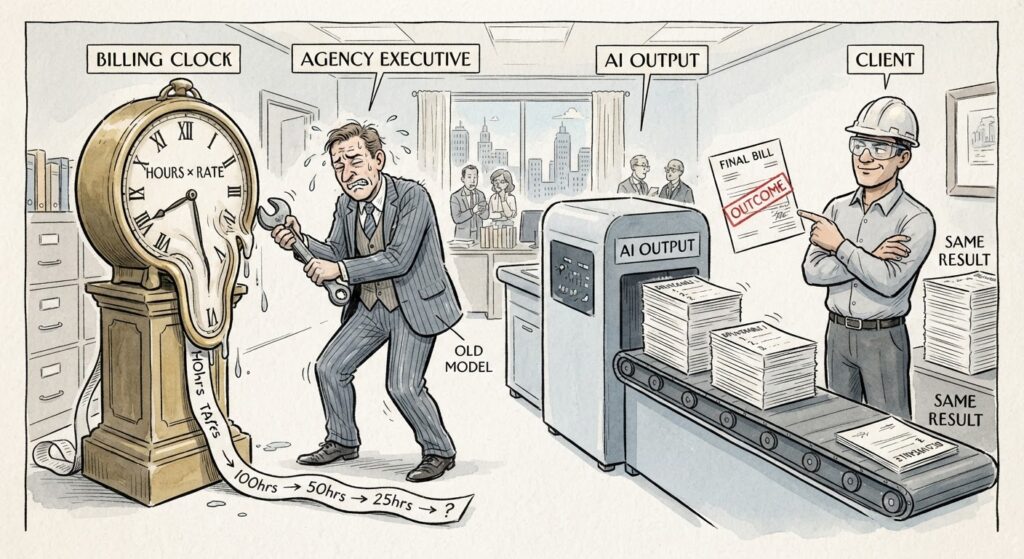
The arithmetic stopped working
Philippe Krakowsky, CEO of IPG, said it plainly in The Drum in July 2025: “traditional time-based remuneration models have become unsustainable, necessitating a shift towards output or outcome-based pricing.” Agency by Agency, October 2025. That is a sitting industry CEO describing a structural break already in motion, not a forecast.
The math is straightforward. AI compresses delivery timelines by 30–50% or more across content, design, and development workflows. Agency by Agency puts it bluntly: “the mathematics simply doesn’t work in agencies’ favour.” If revenue equals hours multiplied by rate, and hours fall by half, you need to double your rate or double your volume just to hold position. Neither lever is easily available at scale.
The model is not under pressure. It is structurally broken. The question is whether your agency is pricing around that break—or still pretending it isn’t there.
Why the pressure accelerated in 2025–2026
Three forces converged to turn a slow drift into a visible break.
First, clients got informed. Revenue Memo (April 2026) reports that 29% of agencies now face direct client pushback on hourly rates, with clients explicitly citing AI productivity gains as justification for rate reductions. Clients are increasingly aware that AI tools can compress delivery timelines dramatically—and they are negotiating accordingly.
Second, AI tooling spend inside client organisations exploded. The median mid-market marketing team’s AI tooling budget grew from $1,200 per month in Q1 2025 to $3,400 per month in Q1 2026—a 183% increase in under 12 months, per Revenue Memo. Clients embedding AI operationally understand its cost structure. Paying agency hourly rates that ignore that reality becomes increasingly difficult to justify.
Third, AI-native competitors arrived with a fundamentally different cost base. Articsledge (August 2026) notes that AI consulting and agency models achieve 80–90% gross margins, versus the far thinner margins of traditional time-and-materials agencies. Competing on hours against firms structured around outcomes is a business model mismatch, not a pricing negotiation.
Who this affects—and how differently
The pressure is not uniform. Junior delivery roles absorb the sharpest impact first. Revenue Memo found that 23% of agencies reduced junior copywriting headcount in 2025, and 31% plan further cuts in 2026. Meanwhile, 66% of agency owners agree that junior team members face fewer career opportunities due to AI automation. The billable-hour workforce base is compressing from the bottom up.
Mid-market agencies with mixed service lines face a distinct version of the problem. They have enough operational complexity to make a full model switch disruptive, but not enough pricing power to absorb margin compression indefinitely. These firms are the most exposed cohort—too large to pivot overnight, too small to absorb losses while they wait.
Legal services offer a useful parallel. Firm-level AI adoption in legal climbed from 26% in 2024 toward 42% in 2026, per LeanLaw (December 2025)—though the 2026 figure may reflect a projection rather than a fully measured result. More than half of legal professionals expect AI-driven efficiencies to fundamentally impact the prevalence of the billable hour. Yet 62% of legal work still runs on hourly billing, illustrating the lag between client demand and industry adaptation that agencies are now entering.
What outcome-based pricing actually requires
Outcome-based pricing is not simply charging more for the same deliverable. It requires redefining what the deliverable is.
Articsledge cites a value-based pricing formula from Business Breakthrough Advisors: price services at 10–25% of the measurable financial outcome delivered to the client. That shifts the agency’s first obligation. Before scoping work, you must establish a baseline, agree on the metric, and define what a measurable outcome looks like. Without that foundation, outcome pricing is just a higher number on the same invoice.
Globant’s approach illustrates one structural alternative. Digital Agency Network (May 2026) reports that Globant launched a token-based subscription model called ‘AI Pods’, where clients pay based on monthly usage rather than hours or fixed scopes. It is a leading-edge model—but it still requires a defined unit of value that clients can track and verify. The measurement obligation does not disappear; it changes form.
The strongest objection to outcome pricing is real and worth taking seriously. These models transfer delivery risk to the agency. If the outcome depends on factors outside the agency’s control—client execution, market conditions, third-party platforms—the pricing model can destroy margin faster than hourly billing ever did. A lower capture rate on an outcome you cannot fully control lowers return; that is a genuine trade-off, not an argument that strengthens the case for switching. The transition works when scoped to outcomes the agency can directly influence, not outcomes it can only contribute to. That scoping discipline is the operational difference between a profitable model and an expensive experiment.
Three concrete steps to start the transition
Migration does not require a full model switch on day one. Revenue Memo reports that 38% of U.S. digital agencies have moved at least one service line from hourly billing to retainer-plus-performance or pure outcome-based pricing in 2026. One service line is a viable starting point.
Audit your highest-AI-impact service first. Identify the line where AI has already compressed delivery time most significantly. That is where the hourly model is most exposed—and where outcome pricing offers the clearest margin recovery opportunity, provided the outcome is measurable and within your control.
Establish client-side measurement before repricing. Outcome pricing requires a shared definition of success. Agree on the metric, the baseline, and the attribution methodology before presenting a new price. Clients who pushed back on hourly rates are more likely to accept outcome pricing when the measurement is credible and jointly owned—but that acceptance is not guaranteed, and the attribution methodology needs to hold up when results disappoint.
Pilot with a client who already understands AI productivity. The 29% of clients actively citing AI efficiency in rate negotiations are the most receptive audience for an outcome-based conversation. Start there rather than with legacy accounts where hourly billing is entrenched and the relationship is built around time-sheet transparency.
Among law firms that adopted AI more widely, 69% saw revenues increase, per Clio (February 2026). That correlation does not guarantee the same result for every agency—firm size, service mix, and execution quality all affect outcomes—but it does indicate that adaptation, not resistance, is the direction associated with revenue growth in adjacent professional services.
If your agency is still pricing entirely on hours in 2026, the model is not under review—it is already failing. The decision is not whether to transition. It is whether you lead the transition or react to it after the margin damage is done.
— Abhijit Ghosh
Join the conversation or subscribe for weekly breakdowns on the structural shifts reshaping how agencies and professional services firms price, deliver, and compete.
Eagentix helps growth-focused enterprises redesign and automate manual business processes. We combine executive strategy, implementation support, and managed services to build dependable operations across Southeast Asia.
Eagentix helps growth-focused enterprises redesign and automate manual business processes. We combine executive strategy, implementation support, and managed services to build dependable operations across Southeast Asia.
Sources
- – Built to withstand: navigating agency life in an era of AI and economic fire – Agency by Agency
- – AI Agency Business Model: How They Make Money
- – AI Is Making Fixed-Fee Legal Billing Inevitable | LeanLaw
- – The Billable Hour in The Age of AI: Risks, Reality & What’s Next
- – Marketing agency statistics for 2026: A comprehensive analysis
- – AI Agency Pricing Guide 2026: Models, Costs & Comparison with Digital Agencies
- – AI Billing Analysis for Smarter Flat Fee Quotes | LeanLaw
- – AI for Professional Services 2026: Costs, Rules, ROI | Tommaso Maria Ricci
- – AI Agents for Marketing Agencies: Complete Guide | MindStudio
- – AI for Agencies: Complete Implementation Guide 2026 | Tommaso Maria Ricci
- – AI & Outsourcing Series: The New Outsourcing Equation – How AI Is Redefining Value (and Pricing Structures) – Tech & Sourcing @ Morgan Lewis
- – Outcome-Based Pricing: The Next Major Shift in Enterprise AI
- – AI Pricing Models: Usage-Based, Outcome-Based, and Hybrid Approaches Explained | TSIA
- – AI agents, outcome-based pricing, and the OpenAI board | Sierra
- – Outcome-based Pricing in Practice: What Outcomes Are AI Companies Really Charging For?
- – The AI pricing and monetization playbook | Bessemer Venture Partners
- – Outcome-Based and Hybrid AI Pricing Models – Futurum
- – What Is Outcome-Based Pricing And How To Use It? | Flexprice
- – How to Transition to Value-Based Pricing for Professional Services
- – Top 10 AI Consulting Firms for Business Transformation in 2026
- – Industry Perspectives: How AI Transforms Professional Services
- – How AI Business Consulting Improves Operational Efficiency
- – AI for Business Transformation: A Step-by-Step Guide in 2026
- – AI Strategy Consulting 101: How Consultants Help Organizations Adopt AI | Coursera
- – Top 9 Artificial Intelligence Consulting Companies in USA
- – What Goes Into AI Consulting Services?
- – AI Consulting for Small Businesses: Your Guide to Creating Outsize Value – Fresh Consulting
- – AI Development Services for Intelligent Business Solutions
- – AI Services & Solutions Consulting | West Monroe